Tuesday, February 10, 2015

rise


I arrived in the theater with the lowest of expectations, but “Jupiter Ascending,” the latest film by the Wachowskis who also brought to us the groundbreaking “The Matrix Trilogy” many years back, turned over its head and was entertaining through and through. And to think that this is not a sequel of any franchise, not based on a comic book or a young adult novel makes it a bold piece of cinema. To make it clear for everyone: It is original. That alone makes every cent for a ticket worth it.

Despite the pastiche of references (a sample was an excellent scene that dives straight into Terry Gilliam territory), the pieces fit well together. For some who knows only a thing or two about pop culture bits from around the world will be scratching their heads though. And there was one big red herring that, I believe, disappointed a lot of critics and resulted to the film’s almost unanimous and overwhelming bad reviews. Don’t believe them. I think they’ve seen an entirely different movie. It was fun, and that’s what matters, right?

Friday, February 06, 2015

call for submissions to the new voices anthologies of poetry and fiction


Attention, new writers: The Department of English and Comparative Literature of the University of the Philippines in Diliman is calling for submissions to New Voices, a two-volume anthology of poetry and fiction by new Filipino authors writing in English. To be published by the UP Press and possibly in cooperation with the Commission on Higher Education, these volumes will provide a platform for new writers to gain literary renown, as well as contemporize teaching materials for Philippine literature in English.

Current anthologies of Philippine poetry and fiction are edited and dominated by well-established writers who form the local literary canon. This practice makes breaking through the publishing and literary worlds difficult for newer authors, many of whom have only published individual poems or stories in magazines and journals. The New Voices anthologies seek to draw attention to a new generation of Philippine writers by filling a gap between the authors’ publication of individual poems or stories in periodicals, and the publication of their first book.

New Voices will feature approximately 15 poets and 10 fiction writers. The selection process will begin immediately after the deadline and end by May 2015. Authors of accepted manuscripts will be notified as soon as the selection process is completed.

The submission guidelines are as follows:

  1. The call is open to new writers of any age who are Filipino citizens holding permanent residence in the Philippines.
  2. A “new writer” is one who has yet to publish a book (sole authorship) in the specific genre for which he or she is submitting a manuscript. A book that comes out before the deadline of submissions for New Voices will disqualify its writer.
  3. Each qualified writer may submit only one manuscript file for each genre. For poetry, the submission file should consist of seven to 10 poems, or the equivalent of 10-15 pages in book form. For fiction, the set of submissions should consist of three to five stories, or a total of around 10,000 words, or the equivalent of 15-20 pages in book form.
  4. There is no prescribed style or theme for the submission contents, but they should represent the author’s skill and range, and as such may or may not have been previously published. If published, however, provide the bibliographical information.
  5. All poems should be pasted in the preferred order, single-spaced, into one document file; the same goes for short story submissions. The prescribed font types are Times New Roman, Garamond, Arial, or Calibri, standard font size 12. Please include a short profile or bionote of no more than 300 words on the last page of the document.
  6. Only online submissions will be considered. The document file to be attached should be in .doc, .docx or .rtf, and labeled with the author’s last name and the title of the first poem or story in the submission (e.g. Arcellana THE YELLOW SHAWL.doc). The filename should also be indicated in the e-mail’s subject line.
  7. The deadline for submissions is 11:59 PM, Philippine Standard Time, on April 1, 2015.
  8. The editors reserve the right to edit any and all materials accepted for publication.


For inquiries and submissions, contact the editors at newvoicespoetry2015@gmail.com or newvoicesfiction2015@gmail.com. Please specify ‘inquiry’ or ‘submission’ in the subject line.

[ info and image lifted from this site ]

call for submissions to ‘sustaining the archipelago’ (an anthology of philippine ecopoetry)


Contributions of poems about nature, species, disasters, environmental justice, and our interrelations with these are now welcome in an anthology of Philippine eco-poetry entitled “Sustaining the Archipelago.”

The importance of compiling our experiences with our ecosystem is evident in what we see around us: our country is one of the 17 megadiverse nations in the world and as such, we live in extreme biodiversity. We are even called, to quote from the 1997 publication entitled “Megadiversity,” one of the earth’s “biologically wealthiest nations.” Yet, those labels are in sharp contrast to our reality of being a “Third World” nation. Using the terminology “megadiversity” to describe any country is appealing, yet it also opens an onslaught of problems which even the Areas of Biodiversity Importance recognize: they say that the nations who are biologically richest are also the nations whose ecosystems are under severe threat. The 2014 Environmental Policy Index confirms this, since the Philippines only ranks 114 out of the 178 environmentally-healthy nations. For one such megadiverse nation, this is an alarming discrepant and an indicator of misaligned values, policies, beliefs, practices, and an overall issue with the utilization of natural resources. It is in the ruthless destruction and degradation of our archipelago that the ecological consciousness of society must be permeated by any means possible – especially through poetry.

What is Ecopoetry?
Ecopoetry has been defined as a poem which investigates both thematically and formally the relationship among language, nature, culture, and human perception of these. It is also widely accepted as a poem which offers a view of the world; an understanding of the nonhuman environment; joy and experimentation with and among nature; and most importantly, an acknowledgment of the responsibility affiliated with writing about the environment. Thus, an ecopoem must not only show the relationship among local language, nature, culture, and human perception, but also investigate the possibilities of offering a view of the environment, an interrelationship with and among species, and the writer’s burden of responsibility in transcribing the natural.

The Future of Ecopoetry in Sustaining the Archipelago 
This project of compiling ecopoems which speak of our ecological interrelationship is to hopefully prove that there is power in language – a power which can effectively show the picture of our lives to awaken our senses, connect us with ourselves and others, and lead us to think in radical ways.

There is a possibility that if we acknowledge the poetic beauty, its force, and capacity to reach out to all of us, we may be given the chance to recognize our responsibilities in maintaining the delicate balance of our ecosystem. In turn, it will allow us to lighten our footprints in our archipelago and in the world. And because poetry speaks personally, its message is delivered quickly, clearly, emotionally, effectively. This anthology may broaden the possibilities of coming up with sustainable solutions to the ongoing environmental crises - a clear and practical way for Filipino writers and their literariness to contribute to the fight against climate change.

Submission Guidelines
Please email your original and published or unpublished ecopoems to the editor, Rina Garcia Chua (rinagarciachua@gmail.com), with the subject heading: Sustaining the Archipelago Submission.

You may send multiple poems or a collection of poems, but it may not exceed more than 10 pages and must be in a Microsoft Word Document file (.doc or .docx). Ecopoems in Filipino and other languages are more than welcome and must be accompanied by an English translation. If your ecopoem has been published elsewhere, please include a bibliography entry of its previous publication at the end of the poem. If it has been simultaneously accepted in another publication, please notify the editor immediately.

Also, follow the filename of your document file/submission as such: lastnamefirstname_titleofcollection titleofpoem.docx (e.g. RotorAbercio_PoemsinTranquility.doc). You can email your essay as a file attachment and include a brief bio-note of 100 to 200 words, institutional affiliation, contact number/s, and email address.

The deadline for submission is on May 15, 2015.

There are a number of confirmed contributors, as well as a foreword from Dr. Greg Garrard, the author of the books Ecocriticism (The New Critical Idiom) and The Oxford Handbook of Ecocriticism. There are also international and local publishers who have shown interest in the anthology. If you have any questions, please do not hesitate to contact the editor via the given email address. 

[ artwork by Marianne Amor Romina Abuan, poster by Jose Avelino Vergara, info and image lifted from this site ]

Sunday, February 01, 2015

heartbreakers

It is no secret our government always fails us like a serial heartbreaker. It doesn’t help that it is mostly run by people who are better off as jesters in the court. Laughable is an understatement.

There’s our Senator Vicente Sotto III who once again quotes the words of our recent celebrity visitor Pope Francis and takes them out of context in a whole new level, inserting his agenda on the opposition of the Reproductive Health Law.

There’s congressman Manny Pacquaio who, once questioned why he isn’t constructing or passing any law during his term—especially that his attendance in the House of Representatives can only be summed up to seven out of 70 sessions—responded that, “Huwag niyo na ako iboto. Mas gusto nga matalo nalang ako. (Just don’t vote for me anymore. Anyway I prefer to lose).”

There’s Joseph Ejercito Estrada who, after being deposed as the nation’s president by a People Power movement because of plunder, ironically returns to power in the form a mayoral seat in the city of Manila, grinning and waving to the deafening cheers of his fans.

And finally, to rub salt in a wound, there’s our current president Benigno “Noynoy” Aquino III who attends the inauguration of a car manufacturing plant instead of the necrological services of the remains of 44 elite policemen who died in a terrifying onslaught in Maguindanao last January, as if he has forgotten his role as the nation’s commander-in-chief.

These are but a few sampling of diseases that plagued the country. A man who is delusional, a man whose fame has gotten into his head, a man who continues to get away, and a man whose priorities have gone bonkers. Even with these facts, facts that are more visible and present than ever, it is sad to note that people continue to put them in power.

It has become a vicious cycle: People vote for these politicians, they say promises. When they perform badly, people groan. When people start to forget, these politicians eye the next elections. When they start to campaign, people listen. Then people vote for them, and then they say their promises again. And we’re back from the very start.

The poet Charles Bukowski once said, “The problem with the world is that the intelligent people are full of doubts, while the stupid ones are full of confidence.” Laugh all you want, but it struck a chord. Perhaps the people do not understand the meaning of “plunder,” or what a contraceptive is, or maybe ignorance, and that primetime news have not done enough explaining on what these things are? Questions, questions.

It looks like the majority of the Philippines can be diagnosed having the Battered Wife Syndrome. And we do not deserve this. We cannot just be full of doubts, groan, and complain throughout the rest of our lives. This cycle could only be stopped if we face the reality and decide to ease our problems long-term and not only for the time being.

Because if we allow ourselves and this nation to be better, then we can really be men and women of intelligence with the right amount of doubt.

* * *

Guys, it’s February. It’s that month of the year that could rival December’s jam-packed restaurants and malls. And just like any old map, X marks the spot. Kaya mag-ingat.


[ image lifted from Facebook ]

Saturday, January 24, 2015

call for submission of manuscripts to the 54th silliman university national writers workshop

Ladies and gentlemen of the written word, it’s time to bring those works out for grinding. Only when needed, of course. And it would be worth your time, I can assure you. There will be grinding, yes, in more ways than one.


The Silliman University National Writers Workshop is now accepting applications for the 54th National Writers Workshop to be held 11—29 May 2015 at the Silliman University Rose Lamb Sobrepeña Writers Village.

This Writers Workshop is offering twelve fellowships to promising writers in the Philippines who want to have a chance to hone their craft and refine their style. Fellows will be provided housing, a modest stipend, and a subsidy to partially defray costs of their transportation.

To be considered, applicants should submit manuscripts in English on or before 9 February 2015. All manuscripts should comply with the instructions stated below. (Failure to do so will automatically eliminate their entries).

Applicants for Fiction and Creative Nonfiction fellowships should submit three to four (3-4) entries. Applicants for Poetry fellowships should submit a suite of seven to ten (7-10) poems. Applicants for Drama fellowships should submit at least one (1) One-Act Play.

Each fiction, creative nonfiction, or drama manuscript should not be more than 20 pages, double spaced. We encourage you to stay well below the 20 pages.

Manuscripts should be submitted in five (5) hard copies. They should be computerized in MS Word, double-spaced, on 8.5 x 11 inches bond paper, with approximately one-inch margin on all sides. Please indicate the category (FICTION, CREATIVE NONFICTION, POETRY, or ONE-ACT DRAMA) immediately under the title. The page number must be typed consecutively (e.g., 1 of 30, 2 of 30, and so on) at the center of the bottom margin of each page. The font should be Book Antiqua or Palatino, and the font size should be 12.

The applicant’s real name and address must appear only in the official application form and the certification of originality of works, and must not appear on the manuscripts.

Manuscripts should be accompanied by the official application form, a notarized certification of originality of works, and at least one letter of recommendation from a literature professor or an established writer. All requirements must be complete at the time of submission.

Send all applications or requests for information to Department of English and Literature, attention Prof. Ian Rosales Casocot, Workshop Coordinator, 1/F Katipunan Hall, Silliman University, 6200 Dumaguete City. For inquiries, email us at silliman.cwc@su.edu.ph or call 035-422-6002 loc. 350.

crying

Last January 14, the Philippines has once again experienced a shot of spiritual high in the form of Pope Francis’ visit just a few days after that frenzy in Quiapo, Manila.

Whether the very warm welcome is a sign of the people’s holiness reaching record-breaking status or simply a typical response of a celebrity-crazed nation (i.e. bringing back to office a plunderer and former action star, making a congressman out of a boxing sensation), the Pope’s short stay has made an impression.

What an impression, indeed. Ever since his inauguration, news all over the world proclaimed him as a great breath of fresh air, a very dynamic, progressive man of faith. Approachable, humble, and bearing a selfie-ready smile for Instagram, the latest Pope can easily bring one’s heart a-flutter.

But in what would be the most head-scratching statement I have heard in this time and age, the Pope said in one of his speeches during his stay in our country, “The Lord will never let you down. Let us move forward, always forward.”

Head-scratching because of this: How?

How can we ever move forward if the very institution the Pope resides in power—an institution millions of Catholics across the globe proudly hold high above anything else like a badge of honor—remains in a very un-progressive and staggeringly un-forwarding stand on the most pressing issues of the world: HIV and AIDS, unbiased opportunity for women to serve as priests, family planning and contraceptives, unsolved charges on pedophilia within the enclaves of their own churches, and anything that connects to the LGBT community like, you know, equality and human rights.

These are just a few of the realities he has been fence-sitting on if not avoiding altogether.

On June 2013, about an interviewer’s question regarding homosexuals going to church, he gave a statement that made international headlines, and probably the conception of him being the beacon of change: “Who am I to judge them if they’re seeking the Lord in good faith?” Of course, people ate it up, threw confetti, or opened a bottle of champagne. But here’s the catch: he actually didn’t say anything about supporting gay rights or accepting the community.

He has mastered the art of ambivalence. As a man who reads Borges, Dostoyevsky, and other great literary writers, he knows what to say. He knows his words.

Also, the Pope is backed up by a target-oriented, well-oiled PR machine. You know PR, right? It is the same machine that creates plans and maneuverings on how to market chocolates to children, whey protein to gym-goers, or a toolbox to stay-at-home dads.

As for Pope Francis, his chief PR is Greg Burke, a 53-year-old former correspondent of Fox News, a channel known to be racist, sexist and anything that insults the intelligence. There is no denying that Burke’s job as the Senior Communications Adviser to the Vatican’s Secretariat of State (yup, that’s his official job title) is a success. He made a media darling out of a pope.

That is why it is beyond me that people still fall for labels “progressive” and “a new hope” and so strongly attach them to a man in robes when clearly nothing concrete has ever changed.

Lastly, this is what’s been bothering me. Upon the Pope’s arrival, the story of children crying at the sight of him stepping out of the plane has been repeated many times over on television, radio, and the internet, putting every possible spiritual spin on it. But is it wrong to consider that these children, perhaps just a few percent of them, fall into fits of tears because, even in the presence of such a powerful and authoritative figure, the Pope cannot actually do anything to eradicate the ills of the world like the scheming and corrupt government officials who kissed the ring on his finger or generally the oppressive society they currently belong? Just asking.

I shared a few thoughts to a friend, and he told me, “Just leave him alone. He’s not doing anything to you.” Exactly, my friend. He has not done anything. It makes me want to cry.

Friday, January 09, 2015

ethics #003

Earlier today, an estimated 5 million Filipinos flocked to Quiapo, Manila to join the largest procession in the Philippines to celebrate the 408th anniversary of the Black Nazarene. In the process of this “tradition,” a man died. Also, there was a lot of screaming, cursing, pushing, shoving, and trampling on fellow human beings to get to a cross. Nothing can be more ironic than this spectacle.

On this side it looked like a tradition that had overstayed its welcome. Believe it or not, some traditions better cease to exist than being practiced. In Indonesia, it is a tradition for a particular tribe’s women to cut a segment of their fingers when their relative dies. In the Faroe Islands, an autonomous country within the Kingdom of Denmark, it is a tradition to slaughter hundreds of whales that could make an entire sea dark with blood.

Traditions can be subjective, especially if it has faith in its core. With our very own procession, as we witness the death, the injuries, and the wanton hurling of trash in the streets rise in numbers through the years, wouldn’t these go against the values of what is holy and divine? What happened to purity, discipline, and cleanliness?

Faith is a sensitive matter and a very tricky one, too.

There’s a father who insists on his wife and kids to go to church, but once inside he wouldn’t last 30 minutes through the service and leave. There’s a woman who preaches the teachings of the bible but remains bigoted and disapproving of what she deems not normal. There’s also a gay man who is partnered yet secretly frequents the cruising spots in town, pays for “service” with strangers, and by Sunday he would kneel down and pray, feeling all the promiscuity washed away with just the sign of the cross, saying he simply embraces who he is and all acts done are part of the process of accepting his true sexuality.

These are not made up. I know these people personally. It seems that faith can be bent at will, a switch that can be turned off when wanted. And it looks like some has an ambiguous idea of it—or have no idea at all. Featured in the news earlier, droves of people are in the middle of the procession like they’re ready for a rave party, expecting some sort of revelry.

Multi-awarded writer Nicolas Pichay shared to me on Facebook: “Our family are devotees of the Poong Nazareno. When I was younger, the procession was never anarchic. It had an internal order that valued solemnity and sacrifice. It is sad that the participants have forgotten this through the years.”

Truly, the essence of the procession has been relegated to the sidelines in favor of loud festivity, meticulous ceremonies, and head counts of attending celebrities. I am no saint, I have my errors. More so, I believe in the power of one’s faith. But at the end of the day, one has to ask: Does it have to be that way?

Wednesday, January 07, 2015

to be resolved

I am bad at resolutions. I believe no one’s good at it—at all—yet every start of the New Year it is full of it. A friend once mentioned he is just glad to have a universally approved day wherein anyone can start all over again. It sounded familiar. I had my reset early last year, and so far, things are rolling just fine. So in 2015, I’m giving these resolutions another shot just to keep me posted on my degree of procrastination and what needs to be done, what needs to be resolved. (This list won’t be absolute though and would change time to time without prior notice).

  • Exercise at least 3x a week (I am busy).
  • Go back to jogging and rehabilitation of my feet.
  • Be more wary of what I eat (Read: limit my intake of chocolates).
  • Continue to minimize intake of alcohol (I actually had neither beer nor rhum in the past six months).
  • Not drink soda (but I need my iced tea and pineapple juice).
  • Visit the doctor regularly.
  • Read at least one book each month.
  • Finish a painting each quarter of the year.
  • Immediately fold the laundry once it is all dry.
  • Learn how to drive a car (I can drive but not in the streets yet—but soon I have to). 
  • Not miss a night using the toner and the moisturizer before bed.
  • Not miss a week exfoliating (I have reached a certain age, thank you).
  • Not spend too much on something that is not urgently needed.
  • Remind myself that not all people is worthy of my time and kindness.
  • Remind myself that I don’t have to feel that way when I feel down.
  • Be good at this new endeavor and then be better. 
  • Do my best on whatever I’d be doing.
  • Discover and listen to old music I have never heard.
  • Wear shades even when the sun’s not out (too much squinting brings out the crow’s feet early).
  • Not post any negative entries on Facebook (I save them for Twitter, my thought-dump).
  • Not raise my voice that often (Sometimes I do need to make a point).
  • Send postcards to friends.
  • Write at least one draft of poetry and finish another one in a month.
  • Write at least a draft of fiction each quarter of the year (I am making it realistic).
  • Write at least one entry in the journal each day no matter how mundane (“I had hotdogs for dinner”), random (“I made a paper boat”), and pointless (“Is it just me or are all the gays I know starting to have the same gay haircut?”) it is to someone with a better journal entry.
  • Keep this blog updated and somehow relevant (because in the last two years this blog was a ghost town).
  • Clean and dust the shoes every other week.
  • Be content more often.
  • Be more grateful that I still know how to keep still and appreciate the silence.
  • Be more honest.
  • Be more careful with my things and with my heart (figuratively and literally).
  • Cherish the people who truly matter.

Saturday, January 03, 2015

a matter of choice: the year 2014 in review


After New Year’s Eve, we always look back and survey the time that has passed, be thankful for having been through the last 365 days even if it is not an entirely smooth ride. Especially for us.

There was a doctor’s recommendation for the operation on my feet that would cost almost a hundred thousand for each foot, an introduction to cancer, a distancing of relationships that continued to stretch further as the days go by, a death in the family, a reappearance of people whose names alone make you sick to the stomach, an instance of flooding in the house that happened twice in a month, and much more that are still difficult to fathom.

It is a heavy way to start a year in review, yes, but this is to underline the sharp pinpricks of light in the darkness, the bits and pieces that remind us about the good: A decision to venture on a path I never knew I could do, a second chance in life during that trip to Sagada last February (I should be on that Florida bus that fell off a cliff and killed numerous lives, including local celebrity Tado, when I changed my mind at the last minute and took a van-for-hire instead), a recognition of a handful of people you can trust and hold on to, an epiphany on the need to burn bridges that go nowhere, a time to be healthy and fit (no alcohol in the last six months, hurrah), a return to the appreciation and creation of art and the occasional literature, a oneness of siblings despite the distances, a mother who makes this lifetime more beautiful and bearable, and a whole lot of blessings in different forms and interpretations.

Indeed, 2014 brought a sense of clarity like no other year has ever revealed: That every act has its place in the order of things, that one’s idea of right and wrong is as unique and different to another, and that one has to get up from where one has fallen with humility as immense as a prayer.

There’s always the distinction between what’s necessary and what’s not, and it is an imperative to recognize this at the soonest time possible. In short, all’s a matter of choice. People hurt you? It’s their choice. People are happy? It’s their choice. People love you? It’s their choice. And it is your choice to respond to their responses in a way that does not demean you but exalts you, makes you stronger and respected no matter how clichéd it goes. Remember, you are not born to harm or to be maltreated.

There are details though from both distant and not too distant past that jolt you up in an ordinary day, but one must keep calm. Especially when it comes to love and its intricacies. What I know from knowledge and wisdom is that it tends to bring remembrances, sinking the anchor that is nostalgia and rekindling what has been and what could be. That is why love can be painful; at times it drags along or clings to the past. If, and only if, that love has always and ever been true.

Though it takes dedicated will, one can break free from the shackles of this very subjective norm.

Last December, while cleaning up the mess in the basement caused by the first episode of flooding, I found a watercolor and ink illustration on board under heaps of paper and rubbish. Based on a note posted at the back, I apparently made it for a project in Physics under a Mrs. Pizzaras last September 26, 2004. That’s exactly a decade ago, when I was once an idealistic, overly optimistic and ambitious 16-year old.

Funny how such mementos could creep up on you at the most unexpected time, bringing you to how things have changed but not entirely so. I kept that high school Physics project, and from that moment I reminded myself once more it’s the good that ought to be remembered.

So this 2015, what I can wish for anyone is to be content even with the littlest of things, to be more honest, kinder, and happier not only for others but for one’s self, and ultimately to wake up each morning and say, “This day’s going to be good.”

To family, friends, and loved ones who stayed, remained modest and truthful, thank you for sharing with us your time and comfort in that trying chapter of our lives. Let’s wake up to new beginnings each day. The sky is never the limit.

Monday, December 22, 2014

read when you can

Just a few days ago, a terrible realization dawned on me while rearranging my bookshelf: Most people, if not all, will never know the likes of Carver, Marquez, Rushdie or Munro. What they only constitute as reading is giggling to cheap thrills of Wattpad. Or worse, the cocktail menu of a bar near you. Wattpad though is a trend, a mobile app wherein one can create stories and share them within a community. If only notable and esteemed writers from across and beyond the nation could contribute works of substance to this app, then we can really safely say that technology has never been a bane but a boon when it comes to reading.

What also pains me to hear from many these days are these common arguments: 1) books are boring, 2) there is no time to read, and 3) there is nothing interesting to read.

The first argument is the most common, and it usually comes from those who refuse to learn despite the awareness of the benefit. We can always tell them to read, yes, but if push comes to shove, we might just have to accept their reality and heed J.K. Rowling’s words, author of the Harry Potter series: “Books are like mirrors: if a fool looks in, you cannot expect a genius to look out.” Harsh, yes, but it speaks volumes of truth.

 The second argument, on the other hand, only emphasizes the elephant in the room that we all have the luxury of time in the world. What we just usually claim to have are excuses. This is where the problem lies. If only we could just take a fraction of our lives to read a newspaper, magazine, or a book of fiction or poetry, in the same manner we ogle at boxers, beauty pageants, fashion shows, and hours of DOTA, I have a feeling our nation would be a much better place to live in.

Lastly, the third argument is empty and lazy, almost like a cousin of the first. The Philippines has a wealth of written works, especially literature. As an archipelagic country, this wealth presents a diversity only a few can boast of. One can easily say ours is an embarrassment of riches.

There is more to Philippine literature than our folktales, Noli Me Tangere, Precious Hearts Romance, and Mabuti Pa Ang Roma May Bagong Papa. We have tales of familiar realities by Alfred Yuson and Jose Dalisay, domestic heartbreak by Ian Rosales Casocot, contemporary fantasy and the otherworldly by Dean Alfar and Eliza Victoria, exquisite verses by Eric Gamalinda, Joel Toledo, and Marjorie Evasco, an acclaimed Boholana critic and poet. On the graphic literature side, there is the piercing wit and humor by Manix Abrera, the inventiveness of Budjete Tan and Kajo Baldisimo, and the timeless satires of Gerry Alanguilan.

Truly there is so much more the Filipinos can offer. There is always something for someone, no matter the genre.

I think many people avoid the library because of solitude. To be alone with only a book as a companion, to be left out by peers and distractions. As if missing the next music playing in the dance floor or an update from an erratic Facebook newsfeed would kill us. But solitude is no disadvantage. Rather it allows us to look deeper into ourselves, away from the unnecessary we usually deem as necessary.

This brings me to one major selling point of a library and the books it houses. What we get from reading is not only erudition and sophistication but also the nuances of the human condition: an understanding of honesty, respect, sacrifice, trust, empathy, and above many other things, love. Love for each other, love for one’s country, or a love for books.

I will end this here, else I would digress further into the stars. There is nothing more to say but this: Take time to visit a library. Give yourself the gift of (re)discovery, a chance to get lost in a maze of books, to be a child once again and give in to the delights of curiosity. As proven since time immemorial, it is through wonderment that we know the possibilities of a future.


[ 2nd of 2 parts ]


Sunday, December 21, 2014

there's nothing more to say but this

These days, to think of a library is almost always like to think of a very distant, analog past. It is like considering the biblical stone tablets over an iPad. But still what a timeless and relevant past it is! Though it is ironic we celebrate books in the digital age, last month’s National Book Week celebration gives me hope for humanity.

Why? Even with the increasing proliferation of technology, it suggests books and what they symbolize for still matter. If we are to believe that books are dead, we must not be having the celebration at all, we would not be having this discussion, and certainly, we would not be in a place where we are right now. Technology is auxiliary, a support factor, and not a hindrance to books and how we enjoy them.

Everyone must have heard of the maxim “knowledge is power.” It is no joke. It is real and proven by history. Knowledge could challenge a dictator (see Benigno Aquino), it could threaten a colonizer (see Jose Rizal), and it could defy false conventions (see Copernicus). This knowledge can be lifted from books, and books can be pulled out of a shelf in a library. Therefore, if knowledge is power, then power is available in multitudes inside the library.

It is easy to shrug this off as another academic speak, like it is some kind of propaganda to wrench people out of their smartphones and plant their heads between the pages of One Hundred Years of Solitude. But this is not the case.

When was the last time you searched for a book in a library not out of obligation but of leisure, out of a deep-seated desire and choice? It is a fact that we go to the mall instead of libraries. We go to the movies instead of libraries. We go to the beach instead of libraries. “A bucket of beer later? Nah. I’d rather go to the library.” I am sure no one’s heard anything of that sort from anybody.

I myself am a victim of these choices. In most weekends I would hang out with friends or binge-watch on Pushing Daisies and The X-Files (old school, yeah?) instead of occupying myself with a paperback. There is nothing wrong with these routines that we cannot shake off from our system, but there is nothing wrong too in allowing ourselves to crack that mysterious book in the nearest library.

It has long been prophesized that the advent of technology—particularly electronic books and reading devices—would replace the physical book, paper and all, thus rendering a genocide of bookshops and libraries around the world. But that did not happen. Although a couple of Barnes & Noble stores are closing in the U.S. and our very own Goodwill Bookstore is now completely erased from memory, we can still sigh with relief that the prophecy was a dud like the Y2K bug of the late 90’s. Even if we have all the gadgets to grab our attention, libraries and books are here to stay. Nothing beats the experience of being surrounded by books when you are hungry for trivial pursuit.

The library, in fact, houses the collective memory of thinkers, from one generation to the next. Getting into one is like being ushered into a hall of blinding light, and only when we get into focus that we would be welcomed by the masters of knowledge themselves. So if we ignore this in a corner like an old, abandoned building, we neglect a vast compendium of ideas. It is our responsibility to uphold these ideas, to sustain the progress these thinkers have made. We can only do this through reading.

That is why with the unparalleled accessibility of information today, it breaks my heart to hear people say “I don’t like to read” with so much entitlement, if not pride. I have a feeling an angel in heaven would drop dead whenever that statement is said.


[ 1st of 2 parts ]

Friday, December 19, 2014

back to the big top


I remember watching the first episode of Daniel Knauf’s “Carnivàle” in 2006 and was left astounded by its vision and orchestration. It had a good versus bad story like no other. It was the very moment I thought television can be greater than the movies. Featuring a world set between the two World Wars and characters so bizarre and meticulously written “Game of Thrones,” “The Walking Dead,” and “American Horror Story” would pale in comparison (even by its opening credits alone), the series was unfortunately cancelled by HBO after a two season run. It was a sad, missed opportunity like so many great TV shows cut short (i.e. “Awake,” “Pushing Daisies,” “Enlightened”). The creator Daniel Knauf kept silent until early last year when he spoke about the grander plan for his show in an article for the AV Club. It is crushing to revisit one’s imagination and talent that never fully get there. But despite the show’s absence in the general conversation of today, there are those who are still enamored by the power of its story. I am one of them. Season 3 should be made.

Monday, December 15, 2014

the end


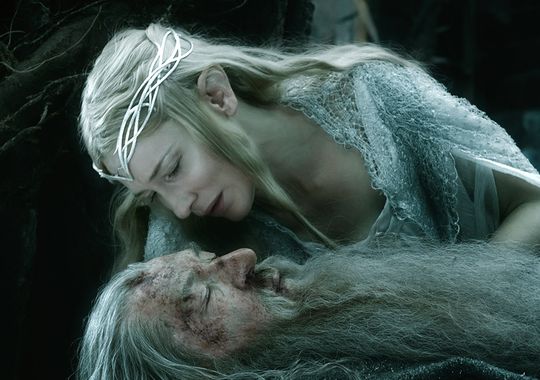
“The Hobbit: The Battle of the Five Armies” does not lend gravitas as much as the third installment of “Lord of the Rings” [2003], but director Peter Jackson’s extended version of the children’s book is decent and entertaining enough to please both readers and non-readers of J.R.R. Tolkien’s novels. Yes, the plot is stretched, but after the first two long-winded films, in here we finally get a brisk and focused tale of harmony over conflict, fortitude over fear, and honor over greed. Truth to one’s words still trump any accomplishment brought about by betrayal and lies. As learned by Thorin Oakenshield the long and hard way, victory and gold are worthless endeavors if one follows a self-centered path. Being the last part of a series of prequels to connect to the grander story that would end the ring to rule them all, “The Battle of the Five Armies” delivers. I’ve wanted more of Bennedict Cumberbatch’s Smaug though.

[ photo lifted from here ]

Wednesday, December 10, 2014

hey

Sexy, isn’t it, the way that one-syllable word purrs into your ears? So daring, yes, so full of character. Or maybe not. It is a word that masters traipsing on the edge of nonchalance, a balancing act of “How’s it going?” and “It’s nothing.” It is bold as it is imposing. One could easily say it demands attention. Like a sore finger, like a thief grabbing your bag, like a blackout shrouding your room in sudden darkness. Here’s a thing. It is in this same darkness its source can be revealed: eager, scheming, Machiavellian. Don’t let it pull you into its depths. Stay away from these people like the plague. Contrary to popular belief, not everyone deserves your kindness. Are you listening? Hey.

Tuesday, December 02, 2014

the year of the flood

We all have our encounters with disaster, whether it is physical or conceptual. Late last year, my home province was shaken by a 7.2 magnitude earthquake, our home luckily spared by its great tremor. But this year, just last week, the same home was flooded within a day’s rain. Our home never experienced a flooding until that morning. The basement level was submerged in water more than two-feet deep, thigh-high. Around the neighborhood electrical lines and cables snapped in halves by fallen trees and debris whisked into the air by strong winds. To think that it was just a signal no. 1 typhoon.

We all have a feeling the said earthquake has tilted not only the land our house is located but every imaginable place around, changing the topography of the island which, in return, has made our area a catch-basin of rainwater. Many accounts have been shared about dry places transforming into miniature lakes, and beaches with the sea retreating away from their shorelines. Indeed, nothing is ever constant, everything shifts and moves, even the grounds we stand upon. Now it is a matter if we move on and move along or not.

*

Update: It has been forecasted that another tropical cyclone is on its way, possibly hitting the Visayas once again by Thursday. And it will be strong. Whether it would really enter the Philippine area of responsibility or not, Bohol, do not rely on resilience. Know your hotlines:

Police Department: 166
Fire Department: 112
Telephone and Radio System Integrated Emergency Response: 117

Sunday, November 30, 2014

last breath

When people ask me how to read a poem (which always happens a lot when they learn about my undergraduate degree), I always tell them to try reading Robert Hass, Stephen Dunn, or Mark Strand. Especially the last one. “Just feel the words,” I would suggest. Meaning, let them sink deep on their own. Poetry, like love, cannot be forced. Though I only know a few poems from Strand, these few have left an imprint of deep admiration in me. That is why when news about his death came this morning, I can only think of this as a token of gratitude for his lasting genius: To read more of his works, to continue feeling his words. Below is a newfound favorite.

*

Breath
Mark Strand (1935-2014)

When you see them
tell them I am still here,
that I stand on one leg while the other one dreams,
that this is the only way,

that the lies I tell them are different
from the lies I tell myself,
that by being both here and beyond
I am becoming a horizon,

that as the sun rises and sets I know my place,
that breath is what saves me,
that even the forced syllables of decline are breath,
that if the body is a coffin it is also a closet of breath,

that breath is a mirror clouded by words,
that breath is all that survives the cry for help
as it enters the stranger's ear
and stays long after the world is gone,

that breath is the beginning again, that from it
all resistance falls away, as meaning falls
away from life, or darkness fall from light,
that breath is what I give them when I send my love.

Friday, November 28, 2014

a good sport

I have once been asked to write something about sports. The closest I could get to was that event in college, the intramural. It has always been a part of many institutions since time immemorial. Its history could be sketchy at best; it could have started in the 1910s or it could have dated back to the era when Greece or Rome are in power, setting up games and competitions in arenas. This alone speaks volumes on how significant sports are in one’s culture.

But in this age of the iPhone 6 Plus, the internet, and other modern distractions, do the young still have time for ball games? Do they still have the slightest bit of interest on rules and discipline along with sweat and dirt? If we at the colleges of today, the answer is simple: Yes. During the intramurals, we see students taking pride in their team colors, taking part in an event that forges solidarity through fair play. There are no different courses and year levels, just skill and talent.

As tirelessly taught by many P.E. instructors, this is the constant agenda: We play to be better not only as an individual but as a community. Like a family. The intramurals are never meant to divide us. And this is the part where I have to probe deeper into the significance of sports among the young people of this generation.

Despite the consensus, a sport is not entirely about victory, power, strategy and strength in numbers. It is about the need to remind the young of the significance of principles such as honesty.

Fairness and truth must be discussed as a major factor in sports as much as being brave, being intelligent, and being pleasant. It must be discussed even more than the usual. Honesty is in fact a multilayered word. There are a lot of ways to interpret it: There was Gilas Pilipinas who admitted defeat to Argentina in the FIBA Basketball World Cup. There was the former cyclist champion Lance Armstrong who eventually revealed his use of performance-enhancing drugs in competitions. There was the regret of having not to play the sports I wanted to play now after suffering from a surfing accident that rendered both of my ankles inept. There was this defeat in a game I thought I was really good at. There are a lot more. Conceding only little.

That is why significance of sports must not only tackle whether there is a need to implement this among the youth or bring up what specific sport is good for them. Significance should also bring to light the values we can learn from sports. Because what good is winning when you have cheated? What good is a strategy when you mean to hurt someone? What good is a trophy if your hands are as dirty as your next lie? 

Indeed, honesty is the foundation of sports, the bedrock of all the other codes and morals that makes the games more engaging, profound, and beautiful. That is why we take the oath of sportsmanship before anything else, right? No amount of medals and recognition would result to honor without honesty. This is the crucial significance in sports that the youth needs to remember now and always.

Honesty though can pull one in different directions. Like a tug of war, there is tension from opposite ends. In a sport that you have lost, you could be left embittered, in surrender to the raw emotions of anger and envy. But on the other hand, you could be liberated from what you think you can do and get up from there. This is the kind of honesty that nurtures humility and would make one say, “Yes, I will do better next time.”

You see, when it comes to sports, we become too preoccupied on the competition, too focused on the reward, and burdened by the desire to outdo one another and to claim that elusive success story that we forget the very core of sports: to be good, to be better, and to be humble. I believe these are what makes one notable, in and out of the court.

To bring this to a close, the significance of sports among the young people of today remains indefatigable. It is ever-changing, never-ending, and tireless like the spirit of a true athlete. And one could only be as such if there is a certain kind of openness and sincerity in his heart. Honesty, win or lose, makes one a good sport.

Saturday, November 22, 2014

art therapy


Christmas came in early this week. Got 36 watercolor pencils all neatly arranged in one fancy tin case. So I made a color wheel as a note to myself for having not made any form of art—visual or literary—in a very long while. It’s a crime on this side of the planet (read: my sanity). Getting back to something you love to do after having ignored it for a year or so is no easy task. You can say it’s a dry spell. I’d like to believe the color wheel above resembles a mandala. This could be my own little universe, your universe, where calmness is the ultimate reward to one’s self, where colors are a salve to the soul.

Saturday, November 08, 2014

musta?

There are ghosts in our lives, dormant and unspeaking, until one day they will make themselves known with "How are you?" or the bastardized "Musta?" Be careful, my friend. They might not mean it. For what reason is their resurgence no one knows. But here's what is likely to be true: They need you. They will need you for their own good. They are that kind of people. This return with a seemingly harmless greeting will be followed by an inevitable pulling of the rug from under your feet. You will never know the accident until you have fallen. Hard. So keep in mind the insincerity behind the word, the cloud of pretense that cloaks the intention, the little details. You will learn and can identify it for sure. You've wielded the same word before, right? Remember how it happened? Musta na?

Friday, November 07, 2014

stellar, indeed.


I had my reservations with Christopher Nolan's "Interstellar." He is the kind of director whose films are always not without demerits: conversations too cerebral, ideas too heavy to take on screen. But it is these very same things that elevate his latest work. By means of science fiction, he presents the most basic desire, and ultimately, need of all human beings: connection. That in itself is notable, having a trait that is absent in many blockbusters that subject their audience with unnecessary bombast and explosions. For sure, there will be negative remarks about the movie (especially from those whose attention span is short and fleeting as a dance floor beat), but I am also sure the naysayers would mistake the film's ambition as high-mindedness, loss as distance, and emotion as coldness and inconsequential. For all its worth, "Interstellar" deserves to be seen. It is that rare film that presents itself with so much thought and feeling at the same time, its heart undeniably on its sleeve. Also, I want to have TARS as a friend.

[ image lifted from here ] 

Tuesday, October 21, 2014

did you miss me?

People who often ask this are most likely to leave you one day or show you the door. They can never wait for you to say you miss them because it is always about them, your attention always for them, that when the minute you look the other way, they can go ahead and wander, having the weapon of assurance that they are those you pine the most, that you would always search for them and return to at the end of the day like bird to its nest. They know you would find it charming, but you should know better. It's a trick, an ace hidden in a sleeve. Now, let me ask you this: Did you miss me?

Saturday, October 18, 2014

ethics #002

Upon Turning To The Last Page

Tuesdays With Morrie, a non-fiction work by Mitch Albom, brings to mind my classes in poetry with renowned writer Myrna-Peña Reyes. Unlike Mitch’s, we met twice a week for an hour each in her home, having one-on-one classes for my final lesson on the craft of building and deconstructing verses. Like Mitch’s, we discussed life, love, death and everything in between.

The book read like an unfinished biography albeit with an arresting conceit which my poetry teacher would surely approve: The author and the subject met every Tuesday, and each Tuesday they had one category for which to wrap around their conversations with. Like there was a Tuesday when it was all about feeling sorry for yourself and another when it was about the fear of aging. It all started when Mitch chanced upon Mr. Morrie Schwartz on national TV, as weak as a broken bird. He was stricken by a strange condition: amyotrophic lateral sclerosis (ALS). In Mitch’s words, it is a “brutal, unforgiving illness of the neurological system.” In my words, it is the disease that brought to the internet millions of amateur video clips of people challenging and dousing themselves with buckets of ice.

It turned out Morrie was Mitch’s favorite professor and he was Morrie’s favorite student back in college. Due to the natural (or unnatural, depending on how you view it) course of living, they both took their separate ways, never to communicate again after many decades until that eventful day in the living room where Mitch was absentmindedly channel surfing. Mitch made it a mission to reconnect to Morrie. From then on the rest, as they say, was history.

Morrie was the quintessential professor; eager to learn and more eager to partake what was learned. He made me wish for more teachers like him. I have only encountered a few, and I will cherish each of them until my very last breath. Morrie and the rest of the few I personally know are the kind of teachers that matter inside and outside the academe. They make every peso paid for education worth it.

Sometimes, though, Morrie seemed more like a fictional character than a real person. He was just too good to be true. How can he be so optimistic? How can he be so brave? My doubt would have grown into full disbelief if not for him being grounded on this faith that I am presently starting to agree with: Be fully present. Morrie insisted that you should be entirely with the person you are with and focus on what transpires between the two of you.

I believe I tend to forget being completely present with people I care about due to modern distractions and old temptations. It seems in this age of excessive multitasking—work on a task here, talk to a friend there, Facebook everywhere—we have come to a point of doing more but actually feeling less. Energy abounds but never the empathy. We never really remember the last time we helped a stranger, we never really notice how our mothers smile anymore. If not the people around us, we also have our environment that we always take for granted. Have you ever acknowledged the skies today have fewer birds than ever before? Have you ever stopped someone from throwing his cigarette butt on the sidewalk? It is shameful.

Through Morrie’s mantra, we can claim what needs to be prioritized. This way we put our attention to not only what matters but also to what makes things exquisite and bursting with meaning. That is why I agree with Morrie. Death is irrelevant, especially in our pursuit for life and love. Ironic, isn’t it, we crave to be ahead of the rest but when we come upon the tracks of death we slow down or scamper away from it? Truly, good or bad, rich or poor, young or old, everyone faces death in his and her due time.

In fact, there is a substitute for death that we can think about. It is honesty. In the 26 years that I have been through life, I think this is what I need the most above everything else, maybe even above love. Love always brings remembrances, setting down the anchor that is nostalgia, which consequently rekindles what have been and what could be. That is why love can be painful; it drags along the past. With honesty, it is all about the present and its repercussions. It is the raw emotion that absorbs truth and deflects bullshit. I am still coming into terms with my understanding of honesty in the context of my actions and from those of the people around me. It is a process I have been working on.

If one argues that death should be feared because nobody wants to be forgotten, I must say we must not forget that there are more to look forward to. It is our attitude towards the future that we can be immortalized. We must not also allow ourselves to be tricked by the deceptiveness of youth and perfection even if they are bombarded to us on television with rejuvenating soaps and lotion, on billboards with perfectly sculpted abs and pectorals, or on the internet with penis enlargers and breast enhancers. The ideal cannot always be the ideal. Most of the time you just have to embrace what you have, love those who love you, and dive into the unknown. No instruction manuals, no second chances. Isn’t this the point of living? If things go wrong, just be at the center of chaos and experience every little tremor around you. That is how instinct and learning works.

For a slim book Tuesdays With Morrie did pack a lot of punch. It brimmed with themes that could fill a library, and all this is not enough. It made me wonder more about existence and its peculiarities. I liked it, so to speak. There is a reason why I am drawn into this and philosophy in general: It gives shape to the abstract and the ghostliness of ideas like hands molding clay. It is like poetry itself, the poetry I have learned with Ma’am Myrna many years ago. Albom’s book was like those hands, too. It managed to run over emotions current and long forgotten, and brought forth emotions that may happen as if I had not experienced them yet.

As I was nearing the end of the book, I felt a kind of heaviness inside me. It was not because of the inevitable death that was about to happen but because of a question that slipped into my head and bloomed like a great, magnificent flower: What can I do now? “A lot. A lot can be done,” I said to myself. Upon turning the last page, I basked in the comfort of that discovery.

Wednesday, October 15, 2014

#bravebohol

On this day a year has already passed since the 7.2 magnitude earthquake struck our beautiful province of Bohol. It changed everything. Too much has been said about getting up after the fall, “bangon,” and this wanton righteousness to connect everything to resilience. But resilience is not enough. Resilience ignores the fact that humans are in nature capable of getting hurt, being miserable, and at a loss for words. Even up to this very moment. This must be the reason why many do not understand what we are commemorating for today: “Happy anniversary para sa earthquake?” or “Plenty have died, why celebrate?” I get it. There is always the weight of enigma that follows an immense, random tragedy. That is why resilience must be taken in a different context, if not taken out of the picture, since it pays no respect to the process of healing, the pains of progress and normalcy. Rather, it is the collective bravery of Bol-anons that we must remember and be grateful for. Being brave is to acknowledge fear and vulnerability, to confront and conquer them. Resilience does not entirely capture that essence. A year has passed, and I can now truly, thankfully say, “Yes, these Boholanos are brave.”

Saturday, September 13, 2014

ethics #001

Differentiate Sociology, Psychology, and Ethics. 

If Plato would have it, I guess ethics will stand above all the other sciences like Sociology and Psychology, and there wouldn’t be that much difference. There is a thread that aims to tie them all: to study man and its nature. He wouldn’t say “Ethics is the supreme science” if he didn’t believe it as such. But actually there is, if we see the other two sciences as variations of Ethics. Though Sociology is concerned with the moral order of a particular society, which really likens it to the science of Ethics and it principles, Sociology focuses more on the relationship between individuals and then to the community. The difference lies on the observance of moral laws and how a community responds to it. In short, the act of observing is Sociology and the concept that is observed is Ethics. Between Ethics and Psychology, the difference is much clearer and basic. Whereas Ethics is concerned on man’s morality, Psychology deals more on what brought man to his idea of morality. It is like the former insists on how one should behave while the latter probes into why one behaves that way.

Give a sample situation wherein a person is liable legally and morally.

The situation that fits a compare and contrast study is usually the act of murder, sexual assault, and other grisly crimes. In this discussion, I will take an example that pervades in our reality right now which is cheating. It is in the movies, television, and even in our daily lives. Cheating is an act punishable by law when it is performed, specifically for a married man in a situation that leads to concubinage (sexual relationship of persons not officially married). With enough evidence, the man that does the cheating is legally liable. When the cheating is not initiated or committed, then the man is still liable, morally. His being morally liable is based on the fact that he thinks of cheating. Not acting it out does not lessen the man’s accountability to the wrongdoing.

To say that cheating is human nature (like the ability to think and to question), since the theory of evolution refers to and/or the origin of population could have started with polygamy and multiple partners, and the guilt that stems from cheating could easily be dispelled by dedication to one’s religion and faith, remains debatable. To me, what is certain is that whether cheating is legally liable or morally liable, both the idea and the act are simply unethical. It is wrong.

Sunday, August 31, 2014

soundbyte #001


The Electric Lady
Janelle Monáe

You know Katy Perry, Lady Gaga and Nicki Minaj. You know nothing about Janelle Monáe. That’s a shame. A darling of many music critics and considered a favorite of Barack Obama, Monáe officially arrived in the industry in 2010 with the studio album The Archandroid that was an intense blast of fresh air. Hers was a music that ranged from R&B, funk, soul to jazz and hip-hop. All this wrapped in a narrative about an android falling in love with a human makes it even more of an entirely different creature. And it surprisingly worked. Now, she continues this inimitable streak with her latest album, The Electric Lady, and has added more genres like cinematic scores, rock n’ roll, and reggae. It is astonishing such vocal prowess and musical dexterity exist in this world. Featuring an array of talented guests like Prince, Erykah Badu, Solange Knowles, Esperanza Spalding, and Miguel, The Electric Lady is by far the album at the moment that would, upon hearing its entirety, linger for many years to come. There’s the single “Q.U.E.E.N.” that celebrates one’s uniqueness (where she spouts some nasty rap in the end), “Primetime” that brings the age-old story of budding love to new light, and “Dance Apocalyptic” that could make the stiffest leg move and dance to its beat.

From orchestral flourishes to arena-size anthems, this girl can perform without the slightest doubt. There are also radio skits sprinkled here and there, and sometimes one might say she is too much. But to say that Janelle Monáe’s work is a jumble of influences is to pigeonhole her in one category. Monáe does not work that way. There is a calculated order in her chaos, a meaning to her excess. The different styles meld together to form one manifesto: to embrace the differences of love and identity, to overcome what brings us down with hope. It is that simple and basically what we need. She’s monolithic in her music, not in a way that imposes but encourages, as if the melodies are whispering, “Let’s listen to something brave and beautiful.” In this industry that is crowded with empty words and saturated in sex and insincerity, Janelle Monáe can be a deity. She is indeed electric like a music messiah who delivers us from all the nonsense. You knew nothing about Janelle Monáe. But this time you do. You are saved.

Essential tracks: “Q.U.E.E.N.,” “Dance Apocalyptic,” “We Were Rock n’ Roll”


Love in the Future
John Legend

When it comes to contemporary R&B love songs, it is hard not to include John Legend as one credible source. Unlike his previous efforts that are a great auditory experience but generally safe, his fourth studio album, Love in the Future, sounds risqué and shoots to the heights of grandness. Its music is sweeping, its character dramatic and sometimes even surreal with its gospel choruses, ethnic-sounding drum sets and morsels of Kanye West beats (not surprising since he is one of the album’s co-producers). The album’s intro sets this tone straight. This time there will be heat, sweat, and messy bed sheets—a far cry from his previous album Wake Up!, a collaboration with The Roots, which is more political than sensual. He is in his top form in this work, his voice consistently clear and strong and his skill with the piano flawless.

At this point in time everyone must have heard of Legend’s chart-topping ballad “All of Me.” Although the track is reverent, it is tinged with a quality that brings to mind the heart-wrenching song, “Someone Like You” by Adele, which made many eyes moist back in 2011. Like that song, “All of Me” has an emotion that is unfiltered and intentions that are frank. Legend’s crooning is reminiscent of a lover whose adoration for someone is an open book. Despite that song’s brooding nature, Love in the Future remains more of an optimist and upbeat than the other way around. It is full of anticipation and brimming with winking candor. Take a trip with “Made to Love,” and in all its thumping beats and handclaps, you will know why it is titled that way. “Hold on Longer” is hopeful, its tunes like a walk in the park on a Sunday morning. “Aim High” is smooth and comforting. In the book An Imperial Affliction, the author Peter van Houten states that “Pain demands to be felt.” With this album, it is not pain you feel but the rapture and bliss of loving, being loved, and making love. Bring out the handkerchief. This time you might end up with tears of joy.

Essential tracks: “All of Me,” “Made to Love,” “Save the Night” .

Sunday, May 18, 2014

original choice

I took it lightly when you said stop,
Thinking ours is a bridge of interludes
That could go on for a lifetime.
From your end of the line there was a
Break. Was it the heater in your room again?
Was it another call from the many people
You randomly met? Or was it a deliberate glitch,
A gavel finally hitting the sounding block?
We have truths as dirty as the workings
Of our hands and we wash them away
Before the tap runs dry. Anywhere,
There is always the drill to be cautious.
Also, there is always a fragment
In our lives that insisted on love.
We could live the latter and spiral
Into surgical dreams of content.
Yet there is no stopping the surge
Of an end like the wings of angels
In fright. So I remember this fondly
As to a strange mineral first discovered,
Remember everything the way gods
Remember me in the future.