Monday, December 15, 2014

the end


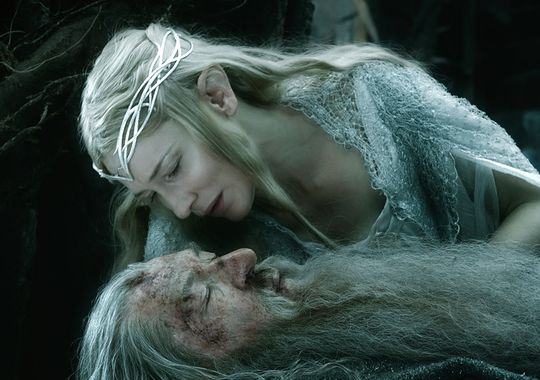
“The Hobbit: The Battle of the Five Armies” does not lend gravitas as much as the third installment of “Lord of the Rings” [2003], but director Peter Jackson’s extended version of the children’s book is decent and entertaining enough to please both readers and non-readers of J.R.R. Tolkien’s novels. Yes, the plot is stretched, but after the first two long-winded films, in here we finally get a brisk and focused tale of harmony over conflict, fortitude over fear, and honor over greed. Truth to one’s words still trump any accomplishment brought about by betrayal and lies. As learned by Thorin Oakenshield the long and hard way, victory and gold are worthless endeavors if one follows a self-centered path. Being the last part of a series of prequels to connect to the grander story that would end the ring to rule them all, “The Battle of the Five Armies” delivers. I’ve wanted more of Bennedict Cumberbatch’s Smaug though.

[ photo lifted from here ]

Wednesday, December 10, 2014

hey

Sexy, isn’t it, the way that one-syllable word purrs into your ears? So daring, yes, so full of character. Or maybe not. It is a word that masters traipsing on the edge of nonchalance, a balancing act of “How’s it going?” and “It’s nothing.” It is bold as it is imposing. One could easily say it demands attention. Like a sore finger, like a thief grabbing your bag, like a blackout shrouding your room in sudden darkness. Here’s a thing. It is in this same darkness its source can be revealed: eager, scheming, Machiavellian. Don’t let it pull you into its depths. Stay away from these people like the plague. Contrary to popular belief, not everyone deserves your kindness. Are you listening? Hey.

Tuesday, December 02, 2014

the year of the flood

We all have our encounters with disaster, whether it is physical or conceptual. Late last year, my home province was shaken by a 7.2 magnitude earthquake, our home luckily spared by its great tremor. But this year, just last week, the same home was flooded within a day’s rain. Our home never experienced a flooding until that morning. The basement level was submerged in water more than two-feet deep, thigh-high. Around the neighborhood electrical lines and cables snapped in halves by fallen trees and debris whisked into the air by strong winds. To think that it was just a signal no. 1 typhoon.

We all have a feeling the said earthquake has tilted not only the land our house is located but every imaginable place around, changing the topography of the island which, in return, has made our area a catch-basin of rainwater. Many accounts have been shared about dry places transforming into miniature lakes, and beaches with the sea retreating away from their shorelines. Indeed, nothing is ever constant, everything shifts and moves, even the grounds we stand upon. Now it is a matter if we move on and move along or not.

*

Update: It has been forecasted that another tropical cyclone is on its way, possibly hitting the Visayas once again by Thursday. And it will be strong. Whether it would really enter the Philippine area of responsibility or not, Bohol, do not rely on resilience. Know your hotlines:

Police Department: 166
Fire Department: 112
Telephone and Radio System Integrated Emergency Response: 117

Sunday, November 30, 2014

last breath

When people ask me how to read a poem (which always happens a lot when they learn about my undergraduate degree), I always tell them to try reading Robert Hass, Stephen Dunn, or Mark Strand. Especially the last one. “Just feel the words,” I would suggest. Meaning, let them sink deep on their own. Poetry, like love, cannot be forced. Though I only know a few poems from Strand, these few have left an imprint of deep admiration in me. That is why when news about his death came this morning, I can only think of this as a token of gratitude for his lasting genius: To read more of his works, to continue feeling his words. Below is a newfound favorite.

*

Breath
Mark Strand (1935-2014)

When you see them
tell them I am still here,
that I stand on one leg while the other one dreams,
that this is the only way,

that the lies I tell them are different
from the lies I tell myself,
that by being both here and beyond
I am becoming a horizon,

that as the sun rises and sets I know my place,
that breath is what saves me,
that even the forced syllables of decline are breath,
that if the body is a coffin it is also a closet of breath,

that breath is a mirror clouded by words,
that breath is all that survives the cry for help
as it enters the stranger's ear
and stays long after the world is gone,

that breath is the beginning again, that from it
all resistance falls away, as meaning falls
away from life, or darkness fall from light,
that breath is what I give them when I send my love.

Friday, November 28, 2014

a good sport

I have once been asked to write something about sports. The closest I could get to was that event in college, the intramural. It has always been a part of many institutions since time immemorial. Its history could be sketchy at best; it could have started in the 1910s or it could have dated back to the era when Greece or Rome are in power, setting up games and competitions in arenas. This alone speaks volumes on how significant sports are in one’s culture.

But in this age of the iPhone 6 Plus, the internet, and other modern distractions, do the young still have time for ball games? Do they still have the slightest bit of interest on rules and discipline along with sweat and dirt? If we at the colleges of today, the answer is simple: Yes. During the intramurals, we see students taking pride in their team colors, taking part in an event that forges solidarity through fair play. There are no different courses and year levels, just skill and talent.

As tirelessly taught by many P.E. instructors, this is the constant agenda: We play to be better not only as an individual but as a community. Like a family. The intramurals are never meant to divide us. And this is the part where I have to probe deeper into the significance of sports among the young people of this generation.

Despite the consensus, a sport is not entirely about victory, power, strategy and strength in numbers. It is about the need to remind the young of the significance of principles such as honesty.

Fairness and truth must be discussed as a major factor in sports as much as being brave, being intelligent, and being pleasant. It must be discussed even more than the usual. Honesty is in fact a multilayered word. There are a lot of ways to interpret it: There was Gilas Pilipinas who admitted defeat to Argentina in the FIBA Basketball World Cup. There was the former cyclist champion Lance Armstrong who eventually revealed his use of performance-enhancing drugs in competitions. There was the regret of having not to play the sports I wanted to play now after suffering from a surfing accident that rendered both of my ankles inept. There was this defeat in a game I thought I was really good at. There are a lot more. Conceding only little.

That is why significance of sports must not only tackle whether there is a need to implement this among the youth or bring up what specific sport is good for them. Significance should also bring to light the values we can learn from sports. Because what good is winning when you have cheated? What good is a strategy when you mean to hurt someone? What good is a trophy if your hands are as dirty as your next lie? 

Indeed, honesty is the foundation of sports, the bedrock of all the other codes and morals that makes the games more engaging, profound, and beautiful. That is why we take the oath of sportsmanship before anything else, right? No amount of medals and recognition would result to honor without honesty. This is the crucial significance in sports that the youth needs to remember now and always.

Honesty though can pull one in different directions. Like a tug of war, there is tension from opposite ends. In a sport that you have lost, you could be left embittered, in surrender to the raw emotions of anger and envy. But on the other hand, you could be liberated from what you think you can do and get up from there. This is the kind of honesty that nurtures humility and would make one say, “Yes, I will do better next time.”

You see, when it comes to sports, we become too preoccupied on the competition, too focused on the reward, and burdened by the desire to outdo one another and to claim that elusive success story that we forget the very core of sports: to be good, to be better, and to be humble. I believe these are what makes one notable, in and out of the court.

To bring this to a close, the significance of sports among the young people of today remains indefatigable. It is ever-changing, never-ending, and tireless like the spirit of a true athlete. And one could only be as such if there is a certain kind of openness and sincerity in his heart. Honesty, win or lose, makes one a good sport.

Saturday, November 22, 2014

art therapy


Christmas came in early this week. Got 36 watercolor pencils all neatly arranged in one fancy tin case. So I made a color wheel as a note to myself for having not made any form of art—visual or literary—in a very long while. It’s a crime on this side of the planet (read: my sanity). Getting back to something you love to do after having ignored it for a year or so is no easy task. You can say it’s a dry spell. I’d like to believe the color wheel above resembles a mandala. This could be my own little universe, your universe, where calmness is the ultimate reward to one’s self, where colors are a salve to the soul.

Saturday, November 08, 2014

musta?

There are ghosts in our lives, dormant and unspeaking, until one day they will make themselves known with "How are you?" or the bastardized "Musta?" Be careful, my friend. They might not mean it. For what reason is their resurgence no one knows. But here's what is likely to be true: They need you. They will need you for their own good. They are that kind of people. This return with a seemingly harmless greeting will be followed by an inevitable pulling of the rug from under your feet. You will never know the accident until you have fallen. Hard. So keep in mind the insincerity behind the word, the cloud of pretense that cloaks the intention, the little details. You will learn and can identify it for sure. You've wielded the same word before, right? Remember how it happened? Musta na?

Friday, November 07, 2014

stellar, indeed.


I had my reservations with Christopher Nolan's "Interstellar." He is the kind of director whose films are always not without demerits: conversations too cerebral, ideas too heavy to take on screen. But it is these very same things that elevate his latest work. By means of science fiction, he presents the most basic desire, and ultimately, need of all human beings: connection. That in itself is notable, having a trait that is absent in many blockbusters that subject their audience with unnecessary bombast and explosions. For sure, there will be negative remarks about the movie (especially from those whose attention span is short and fleeting as a dance floor beat), but I am also sure the naysayers would mistake the film's ambition as high-mindedness, loss as distance, and emotion as coldness and inconsequential. For all its worth, "Interstellar" deserves to be seen. It is that rare film that presents itself with so much thought and feeling at the same time, its heart undeniably on its sleeve. Also, I want to have TARS as a friend.

[ image lifted from here

Tuesday, October 21, 2014

did you miss me?

People who often ask this are most likely to leave you one day or show you the door. They can never wait for you to say you miss them because it is always about them, your attention always for them, that when the minute you look the other way, they can go ahead and wander, having the weapon of assurance that they are those you pine the most, that you would always search for them and return to at the end of the day like bird to its nest. They know you would find it charming, but you should know better. It's a trick, an ace hidden in a sleeve. Now, let me ask you this: Did you miss me?

Saturday, October 18, 2014

ethics #002

Upon Turning To The Last Page

Tuesdays With Morrie, a non-fiction work by Mitch Albom, brings to mind my classes in poetry with renowned writer Myrna-Peña Reyes. Unlike Mitch’s, we met twice a week for an hour each in her home, having one-on-one classes for my final lesson on the craft of building and deconstructing verses. Like Mitch’s, we discussed life, love, death and everything in between.

The book read like an unfinished biography albeit with an arresting conceit which my poetry teacher would surely approve: The author and the subject met every Tuesday, and each Tuesday they had one category for which to wrap around their conversations with. Like there was a Tuesday when it was all about feeling sorry for yourself and another when it was about the fear of aging. It all started when Mitch chanced upon Mr. Morrie Schwartz on national TV, as weak as a broken bird. He was stricken by a strange condition: amyotrophic lateral sclerosis (ALS). In Mitch’s words, it is a “brutal, unforgiving illness of the neurological system.” In my words, it is the disease that brought to the internet millions of amateur video clips of people challenging and dousing themselves with buckets of ice.

It turned out Morrie was Mitch’s favorite professor and he was Morrie’s favorite student back in college. Due to the natural (or unnatural, depending on how you view it) course of living, they both took their separate ways, never to communicate again after many decades until that eventful day in the living room where Mitch was absentmindedly channel surfing. Mitch made it a mission to reconnect to Morrie. From then on the rest, as they say, was history.

Morrie was the quintessential professor; eager to learn and more eager to partake what was learned. He made me wish for more teachers like him. I have only encountered a few, and I will cherish each of them until my very last breath. Morrie and the rest of the few I personally know are the kind of teachers that matter inside and outside the academe. They make every peso paid for education worth it.

Sometimes, though, Morrie seemed more like a fictional character than a real person. He was just too good to be true. How can he be so optimistic? How can he be so brave? My doubt would have grown into full disbelief if not for him being grounded on this faith that I am presently starting to agree with: Be fully present. Morrie insisted that you should be entirely with the person you are with and focus on what transpires between the two of you.

I believe I tend to forget being completely present with people I care about due to modern distractions and old temptations. It seems in this age of excessive multitasking—work on a task here, talk to a friend there, Facebook everywhere—we have come to a point of doing more but actually feeling less. Energy abounds but never the empathy. We never really remember the last time we helped a stranger, we never really notice how our mothers smile anymore. If not the people around us, we also have our environment that we always take for granted. Have you ever acknowledged the skies today have fewer birds than ever before? Have you ever stopped someone from throwing his cigarette butt on the sidewalk? It is shameful.

Through Morrie’s mantra, we can claim what needs to be prioritized. This way we put our attention to not only what matters but also to what makes things exquisite and bursting with meaning. That is why I agree with Morrie. Death is irrelevant, especially in our pursuit for life and love. Ironic, isn’t it, we crave to be ahead of the rest but when we come upon the tracks of death we slow down or scamper away from it? Truly, good or bad, rich or poor, young or old, everyone faces death in his and her due time.

In fact, there is a substitute for death that we can think about. It is honesty. In the 26 years that I have been through life, I think this is what I need the most above everything else, maybe even above love. Love always brings remembrances, setting down the anchor that is nostalgia, which consequently rekindles what have been and what could be. That is why love can be painful; it drags along the past. With honesty, it is all about the present and its repercussions. It is the raw emotion that absorbs truth and deflects bullshit. I am still coming into terms with my understanding of honesty in the context of my actions and from those of the people around me. It is a process I have been working on.

If one argues that death should be feared because nobody wants to be forgotten, I must say we must not forget that there are more to look forward to. It is our attitude towards the future that we can be immortalized. We must not also allow ourselves to be tricked by the deceptiveness of youth and perfection even if they are bombarded to us on television with rejuvenating soaps and lotion, on billboards with perfectly sculpted abs and pectorals, or on the internet with penis enlargers and breast enhancers. The ideal cannot always be the ideal. Most of the time you just have to embrace what you have, love those who love you, and dive into the unknown. No instruction manuals, no second chances. Isn’t this the point of living? If things go wrong, just be at the center of chaos and experience every little tremor around you. That is how instinct and learning works.

For a slim book Tuesdays With Morrie did pack a lot of punch. It brimmed with themes that could fill a library, and all this is not enough. It made me wonder more about existence and its peculiarities. I liked it, so to speak. There is a reason why I am drawn into this and philosophy in general: It gives shape to the abstract and the ghostliness of ideas like hands molding clay. It is like poetry itself, the poetry I have learned with Ma’am Myrna many years ago. Albom’s book was like those hands, too. It managed to run over emotions current and long forgotten, and brought forth emotions that may happen as if I had not experienced them yet.

As I was nearing the end of the book, I felt a kind of heaviness inside me. It was not because of the inevitable death that was about to happen but because of a question that slipped into my head and bloomed like a great, magnificent flower: What can I do now? “A lot. A lot can be done,” I said to myself. Upon turning the last page, I basked in the comfort of that discovery.

Wednesday, October 15, 2014

#bravebohol

On this day a year has already passed since the 7.2 magnitude earthquake struck our beautiful province of Bohol. It changed everything. Too much has been said about getting up after the fall, “bangon,” and this wanton righteousness to connect everything to resilience. But resilience is not enough. Resilience ignores the fact that humans are in nature capable of getting hurt, being miserable, and at a loss for words. Even up to this very moment. This must be the reason why many do not understand what we are commemorating for today: “Happy anniversary para sa earthquake?” or “Plenty have died, why celebrate?” I get it. There is always the weight of enigma that follows an immense, random tragedy. That is why resilience must be taken in a different context, if not taken out of the picture, since it pays no respect to the process of healing, the pains of progress and normalcy. Rather, it is the collective bravery of Bol-anons that we must remember and be grateful for. Being brave is to acknowledge fear and vulnerability, to confront and conquer them. Resilience does not entirely capture that essence. A year has passed, and I can now truly, thankfully say, “Yes, these Boholanos are brave.”

Saturday, September 13, 2014

ethics #001

Differentiate Sociology, Psychology, and Ethics. 

If Plato would have it, I guess ethics will stand above all the other sciences like Sociology and Psychology, and there wouldn’t be that much difference. There is a thread that aims to tie them all: to study man and its nature. He wouldn’t say “Ethics is the supreme science” if he didn’t believe it as such. But actually there is, if we see the other two sciences as variations of Ethics. Though Sociology is concerned with the moral order of a particular society, which really likens it to the science of Ethics and it principles, Sociology focuses more on the relationship between individuals and then to the community. The difference lies on the observance of moral laws and how a community responds to it. In short, the act of observing is Sociology and the concept that is observed is Ethics. Between Ethics and Psychology, the difference is much clearer and basic. Whereas Ethics is concerned on man’s morality, Psychology deals more on what brought man to his idea of morality. It is like the former insists on how one should behave while the latter probes into why one behaves that way.

Give a sample situation wherein a person is liable legally and morally.

The situation that fits a compare and contrast study is usually the act of murder, sexual assault, and other grisly crimes. In this discussion, I will take an example that pervades in our reality right now which is cheating. It is in the movies, television, and even in our daily lives. Cheating is an act punishable by law when it is performed, specifically for a married man in a situation that leads to concubinage (sexual relationship of persons not officially married). With enough evidence, the man that does the cheating is legally liable. When the cheating is not initiated or committed, then the man is still liable, morally. His being morally liable is based on the fact that he thinks of cheating. Not acting it out does not lessen the man’s accountability to the wrongdoing.

To say that cheating is human nature (like the ability to think and to question), since the theory of evolution refers to and/or the origin of population could have started with polygamy and multiple partners, and the guilt that stems from cheating could easily be dispelled by dedication to one’s religion and faith, remains debatable. To me, what is certain is that whether cheating is legally liable or morally liable, both the idea and the act are simply unethical. It is wrong.

Sunday, August 31, 2014

soundbyte #001


The Electric Lady
Janelle Monáe

You know Katy Perry, Lady Gaga and Nicki Minaj. You know nothing about Janelle Monáe. That’s a shame. A darling of many music critics and considered a favorite of Barack Obama, Monáe officially arrived in the industry in 2010 with the studio album The Archandroid that was an intense blast of fresh air. Hers was a music that ranged from R&B, funk, soul to jazz and hip-hop. All this wrapped in a narrative about an android falling in love with a human makes it even more of an entirely different creature. And it surprisingly worked. Now, she continues this inimitable streak with her latest album, The Electric Lady, and has added more genres like cinematic scores, rock n’ roll, and reggae. It is astonishing such vocal prowess and musical dexterity exist in this world. Featuring an array of talented guests like Prince, Erykah Badu, Solange Knowles, Esperanza Spalding, and Miguel, The Electric Lady is by far the album at the moment that would, upon hearing its entirety, linger for many years to come. There’s the single “Q.U.E.E.N.” that celebrates one’s uniqueness (where she spouts some nasty rap in the end), “Primetime” that brings the age-old story of budding love to new light, and “Dance Apocalyptic” that could make the stiffest leg move and dance to its beat.

From orchestral flourishes to arena-size anthems, this girl can perform without the slightest doubt. There are also radio skits sprinkled here and there, and sometimes one might say she is too much. But to say that Janelle Monáe’s work is a jumble of influences is to pigeonhole her in one category. Monáe does not work that way. There is a calculated order in her chaos, a meaning to her excess. The different styles meld together to form one manifesto: to embrace the differences of love and identity, to overcome what brings us down with hope. It is that simple and basically what we need. She’s monolithic in her music, not in a way that imposes but encourages, as if the melodies are whispering, “Let’s listen to something brave and beautiful.” In this industry that is crowded with empty words and saturated in sex and insincerity, Janelle Monáe can be a deity. She is indeed electric like a music messiah who delivers us from all the nonsense. You knew nothing about Janelle Monáe. But this time you do. You are saved.

Essential tracks: “Q.U.E.E.N.,” “Dance Apocalyptic,” “We Were Rock n’ Roll”


Love in the Future
John Legend

When it comes to contemporary R&B love songs, it is hard not to include John Legend as one credible source. Unlike his previous efforts that are a great auditory experience but generally safe, his fourth studio album, Love in the Future, sounds risqué and shoots to the heights of grandness. Its music is sweeping, its character dramatic and sometimes even surreal with its gospel choruses, ethnic-sounding drum sets and morsels of Kanye West beats (not surprising since he is one of the album’s co-producers). The album’s intro sets this tone straight. This time there will be heat, sweat, and messy bed sheets—a far cry from his previous album Wake Up!, a collaboration with The Roots, which is more political than sensual. He is in his top form in this work, his voice consistently clear and strong and his skill with the piano flawless.

At this point in time everyone must have heard of Legend’s chart-topping ballad “All of Me.” Although the track is reverent, it is tinged with a quality that brings to mind the heart-wrenching song, “Someone Like You” by Adele, which made many eyes moist back in 2011. Like that song, “All of Me” has an emotion that is unfiltered and intentions that are frank. Legend’s crooning is reminiscent of a lover whose adoration for someone is an open book. Despite that song’s brooding nature, Love in the Future remains more of an optimist and upbeat than the other way around. It is full of anticipation and brimming with winking candor. Take a trip with “Made to Love,” and in all its thumping beats and handclaps, you will know why it is titled that way. “Hold on Longer” is hopeful, its tunes like a walk in the park on a Sunday morning. “Aim High” is smooth and comforting. In the book An Imperial Affliction, the author Peter van Houten states that “Pain demands to be felt.” With this album, it is not pain you feel but the rapture and bliss of loving, being loved, and making love. Bring out the handkerchief. This time you might end up with tears of joy.

Essential tracks: “All of Me,” “Made to Love,” “Save the Night” .

Sunday, May 18, 2014

original choice

I took it lightly when you said stop,
Thinking ours is a bridge of interludes
That could go on for a lifetime.
From your end of the line there was a
Break. Was it the heater in your room again?
Was it another call from the many people
You randomly met? Or was it a deliberate glitch,
A gavel finally hitting the sounding block?
We have truths as dirty as the workings
Of our hands and we wash them away
Before the tap runs dry. Anywhere,
There is always the drill to be cautious.
Also, there is always a fragment
In our lives that insisted on love.
We could live the latter and spiral
Into surgical dreams of content.
Yet there is no stopping the surge
Of an end like the wings of angels
In fright. So I remember this fondly
As to a strange mineral first discovered,
Remember everything the way gods
Remember me in the future.

Monday, March 17, 2014

rage against the storm


My poem "Original Tempest" made it to VERSES TYPHOON YOLANDA: A Storm of Filipino Poets, edited by award-winning writer Eileen R. Tabios. This groundbreaking anthology that features 132 works from poets in the Philippines and around the world is also a fundraising publication with all of its profits donated to relief organizations assisting the survivors of the largest typhoon ever recorded on land. Support the cause, rage against the storm.

Click here for orders.

Friday, March 14, 2014

we know when we get there


To travel is to make sense of our place in this world. It is by brief moments of displacement that we encounter the marvelous and the extraordinary.

This sparked my consciousness a few years ago when contentment confined me within the corners of my rented unit in Pasig City. Back then, with books by my bedside, to trek the expanse of the world was no problem.

But one day something moved me. There was a switch in me that clicked. I realized one has to go to places, and I shouldn’t be left behind.

Plans were made. Since I had just started my stint in the world of employment, thus wielding disposable income that could only go that much, there was an understanding among my travel buddies that we had to explore our country first before travelling abroad.

So we parasailed and partied in Boracay, hopped from one islet to another in Caramoan, relished the mangoes in Guimaras, snorkeled in the marine reserves in Apo and Balicasag Islands, reveled in the festivities of Cebu, returned to the artistic culture of Dumaguete, surveyed the sugarcane fields in Bacolod, frolicked in the waterfalls in Iligan, braved the whitewater rafting in Davao, bicycled on a tightrope in Bukidnon, explored the caves in Sagada, surfed in Baler and San Fernando (La Union), sated our appetites with delicacies of another San Fernando (Pampanga), and many more. When we almost reached our quota for local flavor, we finally immersed in the cultures of our neighboring Asian cities Kuala Lumpur and Bangkok.

There are far more impressive excursions out there, but in the company of family and friends, the stories we learned and shared were the most rewarding part of the trip. Together our senses were overwhelmed: eye to colors, nose to aromas, skin to textures, tongue to flavors. We had the time of our lives!

And suddenly, something came like a dark shroud and cloaked the bliss I was in. Wanderlust was cut short with bewilderment. What was then a continuing series of wow is now a persistent reflection on why. 

On October 15, 2013, Bohol was struck by an earthquake with a 7.2 magnitude. It took the province by surprise. In seconds hundreds of lives were claimed, homes rendered into rubble.

“Muoli ko” (“I’ll go back home”), I said, but my family in Tagbilaran suggested otherwise. Aftershocks just kept on coming, and it seemed unwise to return to a place with grounds tirelessly quivering. So I waited for things to tide over and prayed.

Then on November 3, typhoon Yolanda loomed. It was headed to Visayas. I prayed even harder. People had hardly gotten up from the earthquake.

The storm only brushed past Bohol, easing the hearts of many from fear. “Kaluoy sa Ginoo” (“God is merciful”), my mother said. But unfortunately not everyone was spared. Yolanda entered the country with a trail of destruction that was historic in its scale and aftermath.

I already knew to travel is to make sense of our place in this world. We know when we get there. But this instance is far from sensible.

A couple of days before Christmas, I got onto Flight 5J617 bound for Bohol. I was not sure how I felt then. Months had already passed since the first blow of the earthquake yet stories of people living in crowded basketball courts or shanties were as fresh as the breaking news on Yolanda.

The minute I stepped off the plane and out of the terminal, my father and mother welcomed me and suggested that we go visit our relatives in Loon, one of the hardest hit towns in the province. I agreed. 

There we saw long stretch of streets cracked like backsides of crabs, bridges that led to nowhere, houses that had either tumbled down a slope, bowed to the ground, crumbled to scraps, or in some instances did what we could only describe as a Pilita Corales—whole structure bent backwards, front door and windows looking up to the skies. It looked like a face in search of answers in the heavens, seeking divine intervention. We laughed a little, but that was only to mask the gloom in the air.

We met a couple of our relatives now living in tents and huts. ‘Nang Edith, my father’s cousin, recounted the tragedy in detail, but neither regret nor confusion was present in her eyes. Instead there was fortitude. Or maybe I interpreted wrongly. Guilt was about to creep on me when my mother asked her how she and her family are coming by.

“Naa ra man gihapon ta diri. Padayon ra.” (“We’re still here. Just carry on.”) She cracked a joke.

Coping mechanism or not, help clearly is still needed. But I admired ‘Nang Edith. Hers was a response I did not expect from someone who had lost so much. She appreciated all the assistance she received, especially those from friends and relatives she both know and never heard for a long time.

We’ve heard a lot about the Filipino spirit and resilience, but nothing speaks volumes like this. And following the wake of Yolanda, the world has witnessed the most notable trait of a Filipino: He can overcome any obstacle and provide aide that equals the force of any earthquake or storm.

We left Loon and returned to the city, bringing a treasure of wisdom. It’s funny how a trip back home turned out to be the most life-changing. Though it is ironic how travel and tragedy seems to be so alike—both changes lives—I am thankful for the present. After the travels we made and despite the tragedies we encountered, my family and friends remain intact and now even stronger.

The calamities of the past made us cross the Rubicon. There is no turning back. There is only one way and that is to go forward, for we must continue venturing to another life-changing trip of our lives. All journeys never end.

Padayon (Carry on).

Monday, September 02, 2013

63rd carlos palanca memorial awards for literature

September, for some, is the month bearing the good news. And this year, for the 63rd edition of the Carlos Palanca Memorial Awards for Literature, a few friends and acquaintances receive the honor. Congratulations, fellows in writing. You know who you are, and all of you deserve it. Here is the complete list of winners:

REGIONAL DIVISION

Short Story - Cebuano
1st: TUBOD, Jona Branzuela Bering
2nd: ANG BATANG TAMSI, Richel G Dorotan
3rd: PADRE BOTOX, Noel P Tuazon

Short Story - Hiligaynon
1st: SI PADRE OLAN KAG ANG DIOS, Peter Solis Nery
2nd: ULUBRAHON, Norman Tagudinay Darap
3rd: TORBIK, Alice Tan Gonzales

Short Story - Iluko
1st: NO WINNER
2nd: BAGNOS PAYEGPEG, BETERANO, Danilo B Antalan
3rd: TI PALIMED NI KATUGANGAK, Gorgonia B Serrano

FILIPINO DIVISION 

Nobela
TATLONG GABI, TATLONG ARAW, Eros Sanchez Atalia

Maikling Kuwento
1st: BAYANGGUDAW, Lilia Quindoza Santiago
2nd: PAMAMANHIKAN, Bernadette Villanueva Neri
3rd: AD ASTRA PER ASPERA, Kristian Sendon Cordero Maikling

Kuwentong Pambata
1st: ANG PAGLALAKBAY NI PIPOY PISO, Maryrose Jairene C Cruz
2nd: ANG SINGSING-PARI SA PISARA, Eugene Y Evasco and Chris Martinez
3rd: SALUSALO PARA KAY KUYA, Lucky Virgo Joyce Tinio

Tula
1st: MANANSALA, Enrique S Villasis
2nd: ASAL-HAYOP, Mark Anthony Angeles
3rd: LOBO SA LOOB, Kristian Sendon Cordero

Tulang Pambata
1st: HARANA NG KULIGLIG, Eugene Y Evasco
2nd: FAMILY TREE NG TUMUBO SA ANIT, April Jade I. Biglaen
3rd: SISID, Alvin Capili Ursua

Sanaysay
1st: OUR LADY OF IMELDA, Kristian Sendon Cordero
2nd: GABAY SA GURONG-LIKOD, Salvador T Biglaen
3rd: MGA BIRTWAL NA KARAHASAN, Laurence Marvin S Castillo

Kabataan Sanaysay
1st: ANG ALAMAT NG BATANG MANUNULAT, Rowin C de Leon
2nd: PAGKATOK NG DUMAGUNDONG NA MANOK SA UMAGA, Annette Irina C Tanlimco
3rd: DEUS EX MACHINA: SAPAGKAT TAYO AY BULAG PA, Rajee S Florido

Dulang Pampelikula
1st: NO WINNER
2nd: KUNG PAANO MAGHIWALAY, George A de Jesus III
3rd: THE REVENGE OF THE COMFORT WOMAN, Patrick John R Valencia

Dulang Ganap ang Haba
1st: NO WINNER
2nd: NO WINNER
3rd: DHAHRAN QUEENS MANILA, Luciano Sonny O Valencia

Dulang May Isang Yugto
1st: MGA KUNEHO, Miguel Antonio Alfredo V Luarca
2nd: KAPIT, George A de Jesus III
3rd: PAMAMANHIKAN, Bernadette Villanueva Neri

ENGLISH DIVISION

Short Story
1st: ARMOR, John Bengan
2nd: KRYSTAL HUT, Erlinda V Kravetz
3rd: REN, Lystra Aranal

Short Story for Children
1st: MARVINO'S LEAGUE OF SUPERHEROES, Nadeth Rae E Rival
2nd: THE MAGIC BAHAG, Cheeno Marlo Sayuno
3rd: A THOUSAND OF PAPER CRANES, Patricia Marie Grace S Gomez

Poetry 1st: PASTORAL AND OTHER POEMS, Mikael de Lara Co
2nd: CROWN FOR MARIA, Carlomar Arcangel Daoana
3rd: ANIMAL EXPERIMENTS, Joy Anne Icayan

Poetry for Children
1st: ATTACK OF THE PERSISTENT COLD VIRUS AND OTHER POEMS, Mia A Buenaventura
2nd: MR BULLY AND OTHER POEMS FOR CHILDREN, Francis C Macansantos
3rd: MONSTERS UNDER MY BED, Kathleen Aton-Osias

Essay
1st: THE KRAKAUER TABLE, Shakira Andrea C Sison
2nd: UNDER MY INVISIBLE UMBRELLA, Laurel Anne Fantauzzo
3rd: VOICES FROM THE VILLAGE, Maria Neobie G Gonzalez

Kabataan Essay
1st: HYMNS OF THE MOUNTAINS, DREAMS OF THE STARS, Marc Christian M Lopez
2nd: PANACEA, Vicah Adrienne P Villanueva
3rd: MANIFESTO OF LITERATURE, Pauline Samantha B Sagayo

Full-Length Play
1st: END OF THE GALLOWS, Jay M Crisostomo IV
2nd: THE SON OF ASHES, Mario L Mendez Jr
3rd: COLLECTION, Floy C Quintos

One-Act Play
1st: BLUE EYES, Allan B Lopez
2nd: DEBRIEF, Lystra Aranal
3rd: CALL OF DUTY, Danilo Nino Calalang

Monday, August 26, 2013

on beauty

Early morning last Friday, with barely enough sleep, hair tied in a tight bun and put into a place by a head band, and eye bags as heavy as the backpack I carried, I stepped into the elevator followed by a woman probably in her early forties. She looked familiar, so I greeted her a good morning. She smiled at me and started a small talk. I thought this is going to be one of those situations when things go awkward until, before stepping out onto her floor, she cheerfully said to me, “Ang ganda ganda mo!” (You're so beautiful!). I didn't exactly know what she saw, but that was enough caffeine to perk me up. I want to hug her dearly.

Thursday, August 22, 2013

something mostly true

Before, the concern of “Don’t be too serious” comes up as often as daylight. In return, the fact that each of us belong to different poles is raised and accepted. Again and again. Well, I thought we did. I embraced the opposite but what I get is a shrug and a casual exodus to whatever that self-interestedly pleases you.

Here is a link that would serve as a reminder, something that I have stumbled upon just this morning. Hope it makes it clearer.

Thursday, August 08, 2013

sands & coral 2013: celebration


This book has been in the works for more than a year, and finally, under the helm of Ian Rosales Casocot, it is coming out this month. A special edition of the Sands & Coral that commemorates the 50th anniversary of Silliman University National Writers Workshop—founded by the Philippine literary monoliths Edilberto Tiempo and Edith Tiempo—it gathers works from select fellows of the said workshop’s half a century run of guiding the young writer’s pen. Thus, it is fittingly called Celebration.

As a writing fellow in the year 2008, I have been invited to share a couple of poems and have also been commissioned to do the illustrations for the anthology. All of this is a first for me. And whether my works would see print in its pages (table of contents not yet revealed), I am still glad to get the opportunity to be involved in this historic project. You see, Sands & Coral, which remains to be one of the Philippines’ oldest academic literary folios, had a hiatus, its last issue seen in the early 2000’s. But now, having this teaser of a book cover circulating the internet, there’s really something to look forward to.