Showing posts with label arts. Show all posts

Tuesday, February 17, 2026

fragile things at dib bangkok


Dib, its name drawn from the Thai word for “raw” or “authentic,” grew out of a long-held dream of Petch Osathanugrah, the late father of Chang. A collector, musician, and heir to an energy-drink empire, Osathanugrah spent nearly four decades assembling a collection of more than a thousand works from across the globe, alongside an equally enduring desire to one day build a museum where these pieces could finally breathe in public. Eventually, the Dib International Contemporary Art Museum was realized. 

Among the works we encountered on February 7, one stayed with us long after leaving the gallery. It was “Incubate” by the Indian artist Subodh Gupta. It features a stack of twenty-five oversized eggs made from stainless steel kitchen utensils, beneath five elaborate chandeliers. The materials are unmistakably domestic and humble but are arranged in a way that feels tense and loaded. As one friend puts it, it feels like our ordinary working-class lives are always beneath or at the service of the elite and opulent. 

All of this is housed in The Chapel, a cone-shaped, acoustically engineered space appended to the main structure. From the outside, it looks like a tower of a power plant. But inside, it is a vessel for something even more powerful and profound.

[ more photos here

Monday, February 16, 2026

round and round at dib bangkok

Last year, on December 20, a renovated 1980s warehouse in Ekkamai, Bangkok opened its doors to the public as the Dib International Contemporary Art Museum, or more commonly known as Dib Bangkok.

On February 7, had the chance to visit this expansive museum. The experience begins even before stepping inside any of the galleries. Scattered across the courtyard is Pars pro Toto (2020), a work by the Polish-German artist Alicja Kwade. She created these eleven natural stone spheres that, depending on where you stand, appear either as oversized marbles or as planets suspended in a solar system. To me, they look like ancient alien debris.

The work forms part of the museum’s inaugural exhibition, "(In)visible Presence,” which invites viewers to reflect on perception and the underlying structures that shape how we experience and interpret reality.

[ more photos here ]

Thursday, December 11, 2025

conversations

F. Jordan Carnice_The Weekly Sillimanian interview

So the former interviewer got interviewed. Yesterday and today, writers from The Weekly Sillimanian and The Silliman Magazine visited the National Museum of the Philippines to speak with me for a feature they’re preparing. Two long sessions. Party because we covered a lot, partly because I definitely went off-tangent more than once. 

We talked about personal projects, literary work in my home province of Bohol, nuances across Binisaya languages. We even tried to define what “literary culture and heritage” means in Negros Island and how institutions like the museum can help sustain it. Plus many small, unexpected detours in between.

It was fun. I remembered being in their place, writing features for The Weekly Sillimanian in 2006-2007, and then serving as features editor in my last two years of college.

When asked what my recognitions mean—whether the Poet of the Year titles from the Nick Joaquin Literary Awards or the recent Pres. Carlos P. Garcia Award—I said they feel like bonuses. They push me to keep writing, yes, but they were never the point. I’ve been writing since I was five or six, stumbling and growing through the work, and these milestones arrived without my chasing them.

F. Jordan Carnice_The Weekly Sillimanian interview 2

Maybe that’s why they’re gratifying. They all came as surprises. I’m already happy sending drafts of poems through text messages to friends and loved ones, the way I’ve done since 2006. I still believe this: when you love the things that work for you, and when you work for the things you love, everything else falls into place.

We then talked about Dumaguete’s UNESCO Creative City of Literature designation. In my heart and mind, Dumaguete has always been a City of Literature. Long before the title, the art thrived through brave, thoughtful souls who kept the words alive. My hope now is that this recognition widens the circle—welcoming more voices, making literature accessible, and helping people see how prose and poetry matter in everyday life, from the tiangge to government offices, from the streets to the academe. 

Thank you, Danielle Mari Bonior, Zarelle Villanzana, Carla Adeline Via. I hope I got the message across.⁣⁣⁣⁣⁣⁣⁣⁣⁣⁣⁣⁣⁣

F. Jordan Carnice_The Weekly Sillimanian interview 1

[ more photos here ]

Monday, February 24, 2020

from father to daughter: the lasting art of napoleon abueva

In the afternoon of February 19, 2020, packs of students, teachers, cultural workers, artists and guests came to the National Museum-Bohol for “The Life and Times of National Artist Napoleon ‘Billy’ Veloso Abueva.” It was a talk that was recounted by the artist’s daughter, Amihan Valles Abueva.

Contrary to popular belief and what is circulating online, Billy was born in Manila, not in Bohol, on January 26, 1930. But this does not negate the artist’s connection to the province. He is after all the son of Boholano congressman Teodoro Lloren Abueva and Purificacion Gonzalez Veloso, a Cebuana who became president of the Women’s Auxiliary Service. He was born Esabelio (that’s why he’s called Billy by family and close friends), but he took the moniker “Napoleon” after his time with the nuns at St. Joseph Academy who kept crying out “Napoleon Bonaparte!” whenever they found him being mischievous for the nth time.

Amihan with a bronze self-portrait bust of National Artist for Sculpture
Napoleon “Billy” Abueva.

Billy had even lived a significant portion of his life here, together with his own family, as evidenced by his contributions to the province: The statues of Pres. Carlos P. Garcia and Dagohoy; the Risen Christ in Our Lady of Lourdes Parish in K of C; the tombstone behind St. Joseph statue at the Cathedral façade; the memorial structure in Balitbiton, Valencia; and the Blood Compact monument (which unfortunately has no plaque or telling signs of origin and artist despite its relevance to Bohol). There are more artworks in the Abueva residence in Duero. All this makes Billy as Bol-anon as the rest of us.

The tribute was a fitting addition to the National Arts Month activities in Bohol, since it was held just three days after the artist’s second death anniversary. Amihan, being an artist herself who usually works with fabric, had lovingly woven the life and works of his father with so much nuance and color.

Amihan shared that her grades in school didn’t matter to her father that much, as long as she would narrate to him the questions she had asked in her classes each day. Curiosity and discovery were important to the family. Billy was also supportive of her political inclinations that he would even suggest to Amihan that he will drive her to a rally in Mendiola. Another anecdote that was amusing for its candidness was when Billy, pressed with a deadline and taken over by temper, would reprimand his art assistants. But they would only laugh behind his back because, like several times before that, they knew Billy will serve them drinks and food when he will eventually realize it is unbecoming of him to get mad at them. “He is a generous artist,” Amihan said.

A stainless steel sculpture titled “Family Group.”
This is just one of the many works by Napoleon Abueva
that are currently on display in the Pagpauli (Homecoming) Exhibit
at the National Museum-Bohol (the old Capitol Building, located across Rizal Park).

For Billy’s body of works, one that gave him the status of being the Father of Modern Philippine Sculpture, Amihan framed her discussion within the trends and significant movements of our history—from World War II and the rise of anti-colonial movements, the anti-racism and civil rights movements, the beginnings of feminism and gender equality, the struggle for democracy and human rights, down to technological advancements and the environment.

This was not only a fascinating peek into an artist’s mind but also a confirmation on the inseparability of politics and arts, the relationship between the environment and the creative process. For Billy, the youngest recipient of the National Artist title to date, the political has always been personal and vice versa. Nothing is made out of a void. And Amihan understands this very well. She is not only a daughter, a mother, and an artist, but also a child rights advocate and human rights activist. In fact, she is one of those at the forefront of opening the doors to child protection, here and abroad, ensuring that children are protected from violence, trafficking, and sexual exploitation.

A rare copy of a self-published book that contains
some of Billy’s masterpieces and the history behind them.

During the open forum, after National Museum-Bohol Head Audrey Dawn Tomada and Gov. Arthur Yap had given Amihan her certificate, I asked her this question: "As an artist and human rights advocate, what words of guidance or encouragement can you give to artists, especially the young ones, in this time of abuse, divide, and disinformation? What can be done? What must be done?"

“Be courageous. Be creative,” Amihan said. “Because artists have a very special role in helping others understand these key issues—disinformation, fake news, tyranny.”

Amihan then highlighted this need to inform and be informed with a question to the audience: “People have been killed in the last three years. For a country that is supposed to be Christian and Catholic, nganu maghilom man ta?”

Amihan also added: “When there are crises, this is the time that the artists come out… If you notice in the times of rebellion, in the times of revolt, diha nanggawas ang mga maayong writer, mga maayong painter. So this is a golden time. Unfortunately, it is a bad time for the victims. But for us who keep on fighting, I think it is a good time to continue the struggle for dignity, for human rights… Stay courageous, stay creative, don’t lose hope.”

Indeed, this boldness runs in the Abueva family, and most definitely manifests in the works of Napoleon “Billy” Abueva. Although his art is informed by the different years of celebration and turmoil in his surroundings, whether in the Philippines or outside its borders, Billy’s masterpieces remain to be both current and future-bound. His sculptures are timeless. Each has a distinct way of mirroring the present but one that is also looking forward. It exudes a creative wisdom that is eager. It is courageous.


[ This article is first published in The Bohol Chronicle on February 23, 2020 ]

Friday, August 17, 2018

ppp2018 : we will not die tonight


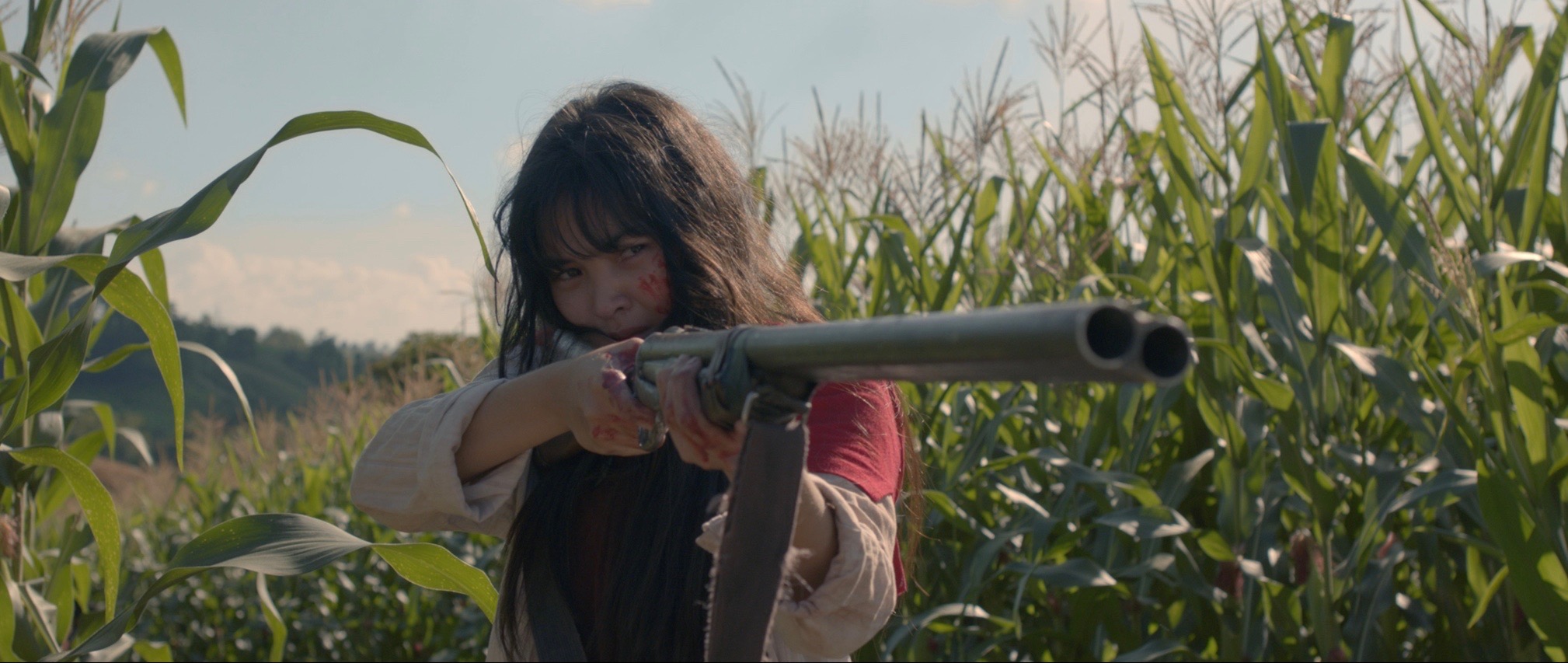
Richard V. Somes’ We Will Not Die Tonight fits in the distinctive space that Pista Ng Pelikulang Pilipino holds, even if this festival is only two years old: good production values, unique plot, famous actors trying out new material. Erich Gonzales’ Kray is a stunt woman, working hard to meet both ends meet for her and her sickly father. Desperate to create her own luck, she agrees to do one last “raket” with her usual troupe of friends who are fellow extras and stuntmen, a job that is proposed by a former lover. Upon meeting their employers one evening, she realizes this is not the job she is looking for, which involves kidnapping street children to slice out their internal organs for some shady market. Shocked and feeling betrayed, Kray and her friends run away from the situation before they themselves would end up on the chopping block. This is a very strong premise, but unfortunately everything goes downhill from here. What starts as a story (seemingly) about a woman fending off every odd that comes her way, especially heightened by the fact that she works hard only to be in the sidelines, abruptly shits into a raucous and messy film that only drowns out everything it wants to say. It has a distracting soundtrack that sounds prepared by an overbearing hipster who worships punk and metal songs. We Will Not Die Tonight could have been our very own take on 28 Days Later [2002] or The Purge franchise but then it becomes a straightforward torture porn packaged as a hide-and-seek game. When a group of middle-aged men search for a little girl in an abandoned warehouse, with machetes in hand, and whisper words like “Do you want me to skin you alive?” with so much glee, you know something is off and unmerited. The film lingers on this type of violence for violence’s sake, relishes on the pounding, piercing, and slicing of the flesh. In short, it becomes exploitative. It is a huge waste because Erich Gonzales here does a better action film than Anne Curtis in the much buzzed-about BuyBust [2018] by Erik Matti. There is a genuine physicality and heaviness in her moves (or her double’s?), her pain onscreen so palpable it could make your palms sweat. Early on in the movie, a character criticizes Kray for her outdated moves on set. Like in the 80’s, too old, nothing new. It turns out this could be the movie’s own criticism.


[ photo borrowed from this site ]
Thursday, July 19, 2018

look what i got!

Lots of people have been asking me how much “damage” was made on my budget during the Big Bad Wolf Book Sale in Cebu last July 12 and 13. But instead of telling you that, I’d show you the “what were bought.” That’s more interesting, right? (Let’s just say the amount I paid could only buy five or six hardbound books if I were in a regular bookstore.)

Weeks earlier, before I went to the sale, I already made a list of authors and titles (based on NYTimes and LA Times book reviews) that I’d want to see in my cart. Most of these are from and by People of Color (PoC), and I was glad I made that list. It made my hunt easier. At the venue, I was also searching for books my favorite writers: Jhumpa Lahiri, Ocean Vuong, Gabriel Garcia Marquez, Wislawa Szymborska, Ada Limon, etc. Sadly, their works were either unavailable in the book sale or I already got of copy of what was on sale.

But all in all I am happy. I haven’t ripped open the packaging yet, because I have made a decision to finish first the three books I am currently reading: Joan Didion’s memoir The Year of Magical Thinking (which I have finished just yesterday!), Shalom Auslander’s short fiction collection Beware of God, and Amy Hempel’s short fiction collection At The Gates of the Animal Kingdom. I am just a few pages away from finishing the last two books. When I am done with these, I’d open three new books. Just like they’re fresh from the bookstore. I am romantic that way.

Not all books I’ve purchased are shown here, in this picture, because I’d be giving them away as gifts to my family this December 2018. Para surprise. Advanced ako magisip.


Here are the books I got:
1. A Field Guide to Reality, novel by Joanna Kavenna
2. Love + Hate, stories and essay by Hanif Kureishi
3. Station Eleven, novel by Emily St. John Mandel
4. Lola Quartet, novel by Emily St. John Mandel
5. The Singer’s Gun, novel by Emily St. John Mandel
6. Ode to Childhood, poetry collection to celebrate the child
7. Life: Great Short Stories by Women, edited by Victoria Hislop
8. Loss: Great Short Stories by Women, edited by Victoria Hislop
9. Love: Great Short Stories by Women, edited by Victoria Hislop
10. Sing, Unburied, Sing, novel by Jesmyn Ward
11. I Am An Executioner: Love Stories, short fiction collection by Rajesh Parameswaran
12. Karma and Other Stories, short fiction collection by Rishi Reddi
13. The Sellout, novel by Paul Beatty
14. To The Moon: An Anthology of Lunar Poems, edited by Carol Ann Duffy
15. The Evolution of Everything, nonfiction by Matt Ridley
16. Love Your Enemies, short fiction collection by Nicola Barker
17. Heading Inland, short fiction collection by Nicola Barker
18. Eveningland, short fiction collection by Michael Knight
19. Mr. Bones: 20 Stories, short fiction collection by Paul Theroux
20. Arcadia, novel by Lauren Groff
21. The Japanese Lover, novel by Isabel Allende
22. We Need New Names, novel by NoViolet Bulawayo
23. Jesus’ Son, short fiction collection by Denis Johnson
24. 600 Decorating Tips & Finishing Touches
25. An Anthology of Flowers
26. Spice: Layers of Flavour by Dhruv Baker
27. Living Art: Style Your Home With Flowers by Olivier Guigni
28. How to Look After Your Kitten by Helen Piers (a must have!)

Sunday, July 15, 2018

12 tips on surviving the big bad wolf book sale in cebu


To my family and close friends, it is no secret that I am huge fan of books. For practicing writers, a book is a fuel that keeps the engines going. That is why I was devastated when I wasn’t able to get to the Big Bad Wolf Book Sale when it first came to the Philippines earlier this year, on February 16, at the World Trade Center in Pasay City.

Big Bad Wolf is a book fair that is touted to be the biggest in the world. It is handled by the Malaysian company, BookXcess, which is owned by the husband and wife tandem, Andrew Yap and Jacqueline Ng.

I was busy, I was preoccupied. Excuses. But luck seemed to be on my side this time. When news broke out that another Big Bad Wolf event would take place in Cebu this July, and a Facebook page of the event started organizing online contests to give away advance or preview passes to winners, I made sure I wouldn’t miss this chance.


And on June 30, I won an exclusive pass for two to the book fair’s Preview Day on July 12, ahead of the official opening on July 13. This meant I’d be one of the selected people who’d get first dibs on the books displayed. #blessedt

I soon traveled to Cebu City and finally found myself in the IEC Convention Center. Before me was a sprawling floor of books upon books upon books. There were gorgeous coffeetable books on design and architecture, beautiful tomes of award-winning literatures, collections of poetry and short stories, biographies and memoirs, book sets for children’s, books for gardening, books for cooking and baking, books for a whole lot of things. Anything you can imagine it is most probably in here. For 60% to 80% less of their original price.


My friend and I entered the book fair at 10AM. We left the venue at 4PM. What an experience. Below are tips and a couple of things we have learned and might prove useful to future visitors to the Big Bad Wolf Book Sale.

Are you ready? Read on...

1. Wear comfortable shoes and clothing.
This may sound negligible, but I tell you, this matters a lot. You’d be moving around the venue for hours just to find the perfect book for you (and probably also for your family and your friends), so wearing something that’s uncomfortable should be the least of your concerns. Besides, this is not a fashion show.

2. Create a list.
Before you go to the book fair, make a list of books (of a particular genre) that you’d like to buy. Save it on your phone. This would serve as your reference and would allow you more time to check out the rest of the items in the book fair. Since genres are each designated to and organized in separate tables, it would be easier for you to locate the area that you need to be in.

3. Do not go in hungry and thirsty.
You won’t be aware of it but you’d spend hours going through all the tables in the book fair, and since the security personnel at the entrance would ask you to leave all your water bottles and snacks outside, it is best that you enter the venue already well-fed and well-hydrated.


4. Bring some friends.
Aside from helping you find the books you want (or simply having someone to approve on the books you want to buy like a motivating coach) and vice versa, a friend could assist you on the books you’ve bought. Compare lists (refer to tip #2) and help each other track down these titles. When you notice the queue to the cashier becomes too long (just like on Preview Day), you can ask your friend to start joining in the line in advance while you continue checking out the tables for more possible purchases.

5. Have loads of patience.
The line or queue to the cashier is always long and winding. The book you’ve always wanted might not be available. The basket of books you leave for a second in one corner suddenly vanishes. People might bump or unintentionally hit you (or worse, hit you with a shopping cart of hardbound books) since the place could get easily crowded. No matter the situation, do not go hysterical. It is easy to be irritated when you are hungry or thirsty (refer to tip #3), but be aware of other people and their spaces. If you have lost a personal item (e.g. wallet, cellphone), immediately approach one of the book fair staff. They are usually wearing those aprons with the Big Bad Wolf print. Breathe in, breathe out. Additionally, expect that the book fair personnel are under intense stress the entire time that some of them couldn’t properly respond to your queries. In fact, most of them are only knowledgeable or aware of the genres and where they are located in the venue, not the specific title or author of a book. So it is pointless getting furious when you do not get the answer you want to hear.

6. Check out everything.
You might only like romance novels or you only read self-help books, but being in a book fair is not the time to be a snob. Widen your horizon, open up your interests, and check out every genre in the book fair (when you are done with tip #2). Believe me, the best books are usually those you do not expect to find and read. You don’t want to miss on that life-changing read, do you?


7. Be a responsible shopper.
Don’t be rude and make other book-lover’s experience a living hell by leaving an item anywhere other than its designated table. This is also helpful to the hardworking staff of the book fair. If you decide not to buy the book you previously put into your basket or cart, please return this book to its proper table. Above all, never ever cut a line or insert yourself in a queue to the cashier. Be mindful and respect other shoppers’ time and effort.

8. Be helpful.
If you find books on the floor, pick them up and return them to the table. And if you chance upon a person who is looking for a particular book that you’ve just recently seen, give that person a tap, a smile, and tell him or her where it is located. There is no harm in helping out a fellow book-lover.

9. Bring extra cash.
Electronic payment is trendy. Credit cards and debit cards provide quick transactions. But sometimes there is Murphy’s Law. Something could go wrong anytime, anywhere. Payment system is broken, perhaps, or you realize you left your cards in the car or at home. So it is best that you bring with you some cash on top of your credit card or debit card. Besides, this cash might come in handy when you go beyond your budget.


10. Bring your own bags.
It is heartwarming to see book-lovers on Preview Day telling cashiers/packers to skip the plastic bags since they are bringing their own eco bags or canvas tote bags for their purchases. Some big-time shoppers even brought with them travel luggage bags to easily wheel their books out of the venue. Although, for some people, it looks “cool” to be seen bringing books in plastic bags with the Big Bad Wolf print plastered on them, it must be noted that all cities across the country have a problem with extreme plastic waste pollution. Land-fills continue to expand as garbage continues to threaten all forms of life on this planet. Let’s not contribute to the problem.

11. Visit more than once.
The venue is huge. Even if you have spent several hours browsing through all the sections in the book fair, there is still that huge probability that you have missed a book over the other. Since the sale runs from July 13 to July 23, and is available to the public for 24 hours each day, it is highly recommended that you return to the book fair and check out the items one more time. Besides, a big bad wolf has told me that more books will be unboxed in the coming days. New titles are definitely on the horizon.

12. Bask in the glow of your purchase.
Be happy with what you have bought. You deserve this. Avoid buyer’s remorse. Ignore people who make snide remarks and tell you that there’s no way you can read all the books you’ve bought. Anything for the joy of reading and knowledge is never a bad thing. Or simply put, anything for what makes you happy is always a good thing. That’s what matters. I bought 27 books, and there are no regrets here. Enjoy your books.


Thursday, June 21, 2018

my baby


Finally. After weeks of preparation and unloading buckets of anxiety, let me introduce you to my first baby: Weights & Cushions, a chapbook of poetry by yours truly.

Most of the poems are first written sometime between 2007 and 2012, and most of them are previously featured in zines, journals, magazines and literary reviews like Dark Blue Southern Seas, Montage, Philippines Free Press, Philippines Graphic, and Quarterly Literary Review Singapore.

Fresh off the printers this morning are 30 copies—20 of which are going to Dumaguete for Silliman University's LGBTQ Zine and Book Fest on June 25, 2018 (Monday) at the SU Main Library, starting at 10AM. The remaining 10 copies would be for people within my perimeters who would think of getting one. If I’d run out of copies, I’d publish another set for you.


I am selling these for P200 each. A bit pricey, I know, because working things on your own turned out to be laborious and costly. (Shipping costs will also be shouldered by the buyer; which is P100 for shipments around the Philippines).

If you want to support and help out a local writer trying to sell his goods that he has worked with sweat and blood, feel free to drop me a message personally. Feed an artist and get him to pay the bills on time. Trust me, you are doing something good with your purchase. Hehe.

Monday, June 04, 2018

in praise of janine berdin

Janine Berdin still got me thinking. I was so mesmerized by her winning performance yesterday on the second season of Tawag Ng Tanghalan Ang Huling Tapatan (even if that was the first time I heard her sing) that I spent the whole night watching her previous performances. Man, glad I did. It was like discovering a sterling talent, a new mineral that has yet to be named. Yes, obviously I cannot stress the superlatives enough.

I am not sure how this would affect her vocal capabilities in the future, whether this is natural or a result of her years-long stint on the stage (and family gatherings), but the crack(s) in her voice when she sings lends her renditions both mortal and ethereal qualities. It is a voice that definitely sits on another plane, at least for me. Don’t get me wrong; her competitors Steven and Ato are undeniably powerful singers but there is something in Janine’s voice that hits me differently the way my ears first heard QUEEN’s “Bohemian Rhapsody”, Adele’s “Chasing Pavements”, Janelle Monáe’s “Cold War.” Perhaps it is her untarnished and optimistic passion? Her focussed drive that could easily dismantle all pretenses and pressure around her? Who knows.

I mean, just watch her cover of Kamikazee’s “Narda” on YouTube and witness how she sang that 2006 rock song and turned it into a painful, forlorn yearning. I got goosebumps, seriously. And there were her renditions of Yano’s “Banal Na Aso” and Eraserhead’s “Ang Huling El Bimbo” where she managed to interpret these iconic masterpieces without getting herself trapped into the easy allure of copy and theatricality—the two-punch combo that TKO’d lesser singers. It is like she wrote these songs herself, knew them by heart. (Honestly, some producer should compile all of her covers and make an album out of ‘em ASAP).

And she is but a little 16-year-old girl from Cebu! Now just imagine when she finally gets acquainted with all the nitty-gritty of every emotion in the spectrum. Just imagine when she finally experiences her first massive, irreversible heartbreak that usually informs and shapes the finest work of many artists. This may sound awful, but deep I inside I cannot wait to see her get through these things soon.

Okay. That’s all.

Monday, April 16, 2018

playing with pop culture


Anything that deals with the past can sometimes be a turnoff to some people, that the antiquated must only be revered in museums, journals, and sweet old memories. But Steven Spielberg’s latest film, Ready Player One, which is adapted from a 2011 novel of the same title by Ernest Cline, tries to flip the table on that mentality. In here, Spielberg proves that the old can actually be just as interesting as the new. Because when it comes to pop culture—which is basically the fabric of this movie—the old is what becomes of all that is treasured.

Aside from being a critique on modern day distractions and anxieties (corporate greed, privacy issues, social media catfishing!), Ready Player One is a wild, visual feast of nostalgia. It’s as if it serves as a geek’s guide to 80’s and 90’s music, movies, pulp fiction, video games, comic books, and other sundry items that are usually deemed too inconsequential for lofty-minded individuals.

The story is set in the year 2045 and introduces us to Wade Watts (played by an effective but easily forgettable Tye Sheridan), a young man who spends most of his time in the Oasis as Parzival, a virtual world created by James Halliday. This is where anything goes, depending on the limits of your imagination (and the digital coins you collect in this computerized reality). Upon the death of Halliday, his avatar (or his digital persona) reveals to all players that there are three challenges to three powerful keys that grant ownership and control of the entire game. Everything changes when Watts meets Art3mis (yes, that’s spelled correctly) who reveals to him that this is no longer a game, when the order of the world is at stake and the gap between classes of society gets even more pronounced—especially that the power-hungry technological company Innovative Online Industries is doing everything it can to take hold of these keys.

Ready Player One has little of the subtlety and poeticism that shaped Spielberg’s other ambitious, fantastical works like A.I. Artificial Intelligence and Minority Report, but it certainly has the frenetic energy of The Adventures of Tintin and War of the Worlds. It just keeps going and going, with little pauses to process all the pop culture references bombarded at you before the next batch arrives.

Yes, it does wholeheartedly embrace the wonders of the past, which give the movie a tendency to tread on clichés and camp and the requisite shots at admiration of the familiar, but all this does not rob it of the fact that it is so satisfying to walk down memory lane. Each scene is like this homage to something exuberant, something vital to our understanding of reality, no matter what time it is derived from. Whether we as viewers are in it for the nostalgia trip or not, this movie sure knows how to play its game

[ photo borrowed from this site ].

Friday, April 13, 2018

new poem published in ecopoetry anthology


A few days ago, I finally received my (paid) copies of Sustaining the Archipelago: An Anthology of Philippine Ecopoetry, which is edited by Rina Garcia Chua, who includes my work "Poetry as a Lesson in Botany" in the collection.

I believe this is the first of its kind in the country; an anthology that attempts to meditate on our nation's concerns and priorities under the lens of ecological understanding. The result is nothing short of fantastic. I just wished the book's contributors though won't have to buy their own copies. Not all writers are, you know, blessed with disposable income. Writing the poem is already hard enough for us. Heh heh.

Wednesday, March 21, 2018

new poem in the sunday times magazine

Now here’s something to be happy about. My poem “Market in Matakana” is published in The Sunday Times Magazine (11 March 2018), the magazine supplement of The Manila Times newspaper. The piece is inspired from a long drive to the North Island town of Matakana in New Zealand. I hope I did it justice though. That place was just brimming with so much beauty.

Here is a link to the poem in case you can’t get a copy of the paper.

Thursday, March 15, 2018

ang larawan: review and observation


The journey of Loy Arcenas’ award-winning film, Ang Larawan, to Bohol is one that parallels the difficulties of getting it made and seen by an audience in the first place. It was never shown in any of our malls during the entire run of the Metro Manila Film Festival 2017 last December and January. When it got the chance to be screened in Bohol, it was cancelled and moved to another date due to typhoon Basyang. But the fates are still good, the hardworking culture-bearers of Bohol better.

Continuing the activities of this year’s National Arts Month, and being part of a school tour that would also take the film to Cebu and Negros Oriental, Ang Larawan is finally shown with two screenings at the Bohol Cultural Center on February 19.

Before the 7:30PM screening, the Loboc Children’s Choir performed a suite of pop musical pieces. Actors and producers Celeste Legaspi and Rachel Alejandro also sung in a cappella, after joining Loy Arcenas and producer Alemberg Ang for a symposium. The four of them fielded questions from the audience that touched on characterization, how commercialism could coexist with art, and the need for micro-theaters (or cinematheques) in provinces like Bohol that could readily accommodate unconventional, non-mainstream works and provide movie consumption diversity.

And how lucky these students and teachers were, these culture and art enthusiasts, these regular moviegoers, to finally experience Ang Larawan. Rarely do Boholanos see a Filipino musical of this pedigree. It is not just different for diversity’s sake; it is a landmark in Filipino artistry. This movie is based on a stage musical with translation and lyrics by National Artist for Theater and Literature Rolando Tinio and music by Ryan Cayabyab, which is also an adaptation of the play A Portrait of the Artist as Filipino by National Artist for Literature Nick Joaquin.

Ang Larawan is set in 1940s Intramuros, before World War II, and focuses on two spinster sisters, Candida and Paula Marasigan, who live in a cavernous house with their artist father Don Lorenzo—the man who painted the titular larawan and who kept to himself inside his room for a year and counting after a mysterious tragedy. The once glorious household, where the alta sociedad frequently mingled, now relies on financial support provided by their siblings Manolo and Pepang, who both agree it is better to sell the property than to hold on to it like dead weight. But all this could not hold up to the daily expenses; Candida even considers her rat-catching talent and Paula’s fluent Spanish as lucrative jobs, but both eventually acknowledge this is not true. Thanks to Tony, a charming vaudeville piano player and male boarder who the two sisters have to take in, the idea of selling the last Marasigan painting for $20,000 to an American collector is put on the table. This sets Candida and Paula in a head spin and moves the story forward to situations no one would ever expect (unless you have seen or read the original play).

The movie is so lovingly made, as evidenced from the very first frame down to the last melody of a song. It is the type of movie that grows on you even as it confronts you with difficult, conflicting ideologies—principle or practicality, heritage or commercialism. Even if it brims with the gilded beauty of the past, it is not afraid to remind everyone that everything can be preserved as much as it could be ravished by the consequences of a decision or force that is beyond anyone’s control. Very much like a representation of how the culture and the arts in this country often balance on a precarious tightrope. The movie does not explicitly take sides, but any logical viewer can instantly decide where one must lean on. In fact, Joanna Ampil’s tremendous portrayal of Candida drives home the message.

The only hitch in this near-perfect production is that its movements stick closely to the structure of theater, that sometimes the pacing feels lumbering and too deliberate for a movie. There is no questioning the genius of Rolando Tinio’s libretto and Ryan Cayabyab’s compositions (whose score breezes through bombastic jazz and zarzuela), but the musical exposition it employs is in the vein of a Stephen Sondheim musical; the songs can be hard to sing along with.

It is easy to brush off this movie as another passion project that’s weighed down by its own ambitions, which makes it dismissible by an audience contented with slapstick humor and cheap thrills, but the movie’s mere presence in this time and age, let alone in Bohol, should be enough indication that we do have something great and important in our hands, that something even more precious could arrive someday. Has anyone heard of the movie Smaller and Smaller Circles by Raya Martin that features a host of Boholano talent but is unfortunately never shown in our cinemas in 2017?

It is no simple task, to remind everyone of this when people are getting used to with what they usually get (read: horror, romantic comedy, Vice Ganda), but last Monday’s audience turnout, with the help of both the local government body and private sector, suggests that a cultural renaissance is indeed possible. These are all concerns and ideas that have yet to meet a solid, committed prioritization in Bohol, but for now, let us at least revel at the thought that, at long last, the portrait is finally unveiled to Boholanos. To echo one of the movie’s cries, contra mundum!


[ article previously published in The Bohol Chronicle, 25 February 2018 ]

Monday, February 19, 2018

balut beer ug balak 2018 : the heart is in the words

February is practically baptized by many as the Love Month. But last February 11 at the CPG Heritage House Open Grounds, the evening professed a different kind of love that goes beyond flowers, chocolates, and candlelit dinners.


In celebration of this year’s National Arts Month, Kaliwat ni Karyapa (KaKa) Writers Collective, with the support of the Center for Culture and Arts Development (CCAD) and the Office of the Governor of the Province of Bohol, opened the seventh iteration of Balut Beer ug Balak (which is concisely hashtagged on social media as #BBB2018).

Lutgardo "Gardy" Labad introduces Kontra-GaPi and Kasing Sining

What started as a struggle to get the literary arts recognized in the province’s many festivities is now an event that justly merits the praise and attention it received last Sunday night. Back in the old days, there was significant support for all forms of Boholano art—except for the literary. There were budget and regular gatherings for music, dance, painting exhibitions! Unfortunately, there was none whatsoever for poetry and other writing affairs. If there was one, only little was heard of it, the fanfare muted like a cold grave shrug.

Kontra-GaPi dazzles the audience with a rallying ethnic music (source: CCAD)

As a rebellion and as a need to balance the field, considering that our nation has a writer hordes cherish as their national hero (Jose Rizal) and once had a prolific Boholano writer-lawyer as a president (Carlos P. Garcia), like-minded individuals united and pushed for an activity that celebrated the letters. They put emphasis on poetry, our very own balak, because it does not only encapsulate the yearnings of the Boholano heart but also humanity’s soul. KaKa, the writers collective whose rich history demands a separate article, was at the forefront of this endeavor.

Theater arts group Kasing Sining performs an excerpt of the musical 'Dagon sa Hoyohoy' (source: CCAD)

So for Sandugo 2004, the balak was brought to the public space. Since it was first held at the formerly scenic city pier, a combination of balut and a glass of beer was unanimously deemed the most felicitous reward for (non-minor) readers and performers. No pressure from anyone to present; it was simply done for the joy of this groundbreaking occasion.

An obligatory photo of me trying to drive home the message while presenting my piece

Thus, Balut Beer ug Balak was born. The singular dream to have Bohol’s varied literary voices heard is now a reality. For its latest appearance, BBB has even become more than its namesake. With Lutgardo Labad’s considerable generosity, the event last Sunday was graced by UP Diliman’s Kontemporaryong Gamelan Pilipino (or better known as Kontra-GaPi), and our very own theater arts group, Kasing Sining, who presented an excerpt of the Boholano musical folk-epic Dagon sa Hoyohoy.

Becky Demetillo-Abraham of Inang Laya performs with Butch de Juan

And like most events, BBB was not spared of how things could never go as planned. It was unanticipated, the number of mambabalak and volunteer readers was high, and the programme lasted longer than it should be. There were several presenters who read their original works that touched on emotions that may be too big for them to grasp, like young singers straining for the celestial notes, while some disconcertingly tackled delicate issues with humor, which could have been handled with more sensitivity and thought, especially for impressionable minds. It’s a common misconception that spoken word poetry must always traverse the territory of crass and shock.


Some of the guests, performers, and readers of BBB 2018 (source: CCAD)

But in the end, creativity requires influence, and an occasion such as Balut Beer ug Balak provided the perfect avenue for this much-needed enlightenment, as seafarers to a fortified parola. We are each other’s guides. Possibly and hopefully, in its next iterations, BBB could be not only a regular gathering to celebrate the literary arts but also as an occasion for everyone to better map the landscape of our current realities and to better maneuver the terrains of the Boholano imagination and emotion.

See you next time!

Because poetry is confirmation. It sparks in you what you knew all along. It is the language of the heart and the soul and their attendant nuances—love and rage, celebration and loss, resistance and surrender—and all this makes the entirety of literature even more transcendent, beautiful.


[ the article is previously published in The Bohol Chronicle, 18 February 2018 ]

Friday, February 16, 2018

wherever


Just got wonderful news. Three of my works—“Paulit-ulit”, “Paano Maglakbay Papuntang Kalawakan at Iwasang Bumalik”, and “Mula Enero”—are published in the collection of dagli or flash fiction, Saanman: Mga Kuwento Mula sa Biyahe, Bagahe, at Balikbayan Box, edited by Jack Alvarez. I hardly write in Filipino, and these three pieces are just a result of exorcising the demons of a tumultuous 2012-2013, so this is a real surprise. Well, this is a great way of greeting the last few days of our country’s National Arts Month.

A copy of the book can be purchased via the following links below:

Amazon
Lazada
Shopee 

Thursday, February 08, 2018

new poem up in quarterly literary review singapore

My poem “Habits” is published in the latest issue of Quarterly Literary Review Singapore, along with works by fellow Filipino authors such as Rodrigo Dela Peña Jr., who is one of the contemporary poets I look up to.

Early lines of this piece first came up in 2012, and through the years the poem took several phases of (re)formations. I dedicate this poem particularly to Lyde, Marianne, and Mars for being with me that one August night.

Okay, thank you for your time. You can check out the poems through the link here.

Saturday, November 18, 2017

call for manuscripts to the 57th silliman university national writers workshop


The Silliman University National Writers Workshop is now accepting applications for the 57th Silliman University National Writers Workshop to be held from May 7 to May 18, 2018 at the Silliman University Rose Lamb Sobrepeña Writers Village and the Silliman University campus.

This Writers Workshop is offering ten fellowships to promising writers in the Philippines who want to have a chance to hone their craft and refine their style. Fellows will be provided housing, a modest stipend, and a subsidy to partially defray costs of their transportation.

To be considered, applicants should submit manuscripts on or before January 5, 2018. (Extension to the deadline will not be made.) All manuscripts should comply with the instructions stated below. (Failure to do so will automatically eliminate their entries). Applicants for Fiction and Creative Nonfiction fellowships should submit three to four (3-4) entries.

Applicants for Poetry fellowships should submit a suite of seven to ten (7-10) poems. Applicants for Drama fellowships should submit at least one (1) One-Act Play. Each fiction, creative nonfiction, or drama manuscript should not be more than 20 pages, double spaced. We encourage you to stay well below the 20 pages. Aside from manuscripts in Poetry, Fiction, Creative Nonfiction, and Drama that should be written in English, the Workshop this year will be accepting manuscripts for Balak (poetry in Binisaya). Applicants should submit a suite of seven to 10 (7-10) Balak entries with their English translations.

Manuscripts should be submitted in five (5) hard copies. They should be computerized in MS Word, double-spaced, on 8.5 x 11 inches bond paper, with approximately one-inch margin on all sides. Please indicate the category (FICTION, CREATIVE NONFICTION, POETRY, ONE-ACT DRAMA, or BALAK) immediately under the title. The page number must be typed consecutively (e.g., 1 of 30, 2 of 30, and so on) at the center of the bottom margin of each page. The font should be Book Antiqua or Palatino, and the font size should be 12.

The applicant’s real name and address must appear only in the official application form and the certification of originality of works, and must not appear on the manuscripts. Manuscripts should be accompanied by the (1) official application form, (2) a notarized certification of originality of works, and (3) the form letter of recommendation from a literature professor or an established writer. All requirements must be complete at the time of submission.

Send all applications or requests for information to the Department of English and Literature, attention Assistant Professor Lady Flor Partosa, Workshop Coordinator, 1/F Katipunan Hall, Silliman University, 6200 Dumaguete City. For inquiries, email us at silliman.cwc@gmail.com or call 035-422-6002 loc. 350.

Monday, November 06, 2017

please come in


Nothing prepared me for the boldness and elegance of Prime Cruz’s “Ang Manananggal sa Unit 23B.” It has all the elements of a regular horror flick—a recognizable myth, a moody atmosphere, two attractive leads. What veers it away from standard Filipino work of this genre is how it entirely rewrites what we expect. There are long deliberate pauses here that would make an audience uncomfortable, especially those who have been conditioned by jump scares, screams, and cries. It is no easy task, but Ryza Cenon’s Jewel and Martin del Rosario’s Nico carry these silences into a heightened performance, such as an exquisite display of an arched back here or a slumped shoulder there. It is all about the body. For a movie with a mythological self-segmenting creature in its title, it should be about the body. And one can identify that this movie leans heavily on vampire retellings like Tomas Afredson’s “Let The Right One In”—primal, brooding, sensual. It is unapologetic on how it handles sexuality, particularly female sexuality, which is a welcome surprise in this country still steeped in machismo and misogyny. This is evident in Jewel’s transformation, how her sprouting of wings is like giving birth to a new life. Although it is difficult for her, considering her newfound attraction to Nico, her decision to still go after fresh meat is wholly her own. In the Age of Trump and Duterte, the urge to inject a political slant into entertainment has become more recurring than ever that it now resembles some form of moral duty. “Manananggal” is not spared from these intimations; it has chosen a hot timely crisis (of which I won’t divulge), and yet for all its good intentions, it has not fully enriched or broadened the discussion to greater effect. In fact, it has muddled “the important politicized idea” even further. But thinking about it now, it looks like that is the point of the movie. The whole world is now a mess, and for most people who do not know what to do, aside from ignoring or screaming at each other, the wise thing to do is to straighten up our act and pick up the pieces—such as the viscera of a manananggal’s latest victim.

[photo borrowed from this site]

Monday, September 25, 2017

right on target


Mikhail Red’s “Birdshot” is a work of art. The film centers on 14-year-old Maya who lives with her father Diego in some undisclosed farmland. Diego’s wife died in childbirth, and he is getting old, so he tries everything he can to teach Maya the ways of living—and that includes hunting. One day, with her shaggy black dog Bala, Maya finds her way to the sanctuary. She needs to prove to herself that she could stand on her own, and this brings her to an irreversible decision that changes everything. She unknowingly shot a haribon, a Philippine Eagle that is now close to extinction due to urban developments, illegal logging, and forest burning. This is where police officer Mendoza and his rookie subordinate Domingo come in to investigate. It’s hard giving justice to its brilliance without spoiling it. Even if “Birdshot” utilizes the methods of a police procedural and the coming-of-age story, it propels forward to places that you’d never expect, to situations that would unnerve and jolt you. Red’s direction is close to perfect. He has the polish of Chito Roño, poetic flourishes of Lav Diaz, the critical sensibilities of Marilou Diaz-Abaya. The absence of the specificities of time and place gives “Birdshot” an almost mythic feel. Everything's not what it seems to be—scarecrows seem to come alive, shadowy figures lurk in corners—and this is best portrayed by how complacency and good intentions of a higher system can actually have deeper, more sinister motives. Idealistic minds could get corrupted. In one scene, John Arcilla’s Mendoza tells his partner, “Trabaho lang yan… iinom lang natin yan”, and you cannot help but think of our country’s nightmares that consume our waking moments—like the innocent 17-year-old Kian Delos Santos who was killed by police officers last August 16. As the end credits rolled, I suddenly felt all the wrong decisions this country has made, and just broke down and cried. Fiction creeping into reality is nothing new. But when the distinctions are blurred or altogether removed, when life becomes stranger than fiction, it is high time we stand up, speak out, and remedy the situation. “Birdshot” is that eagle’s cry we all need to hear.


[ photo borrowed from this site ]